
At Remcon Equipment, we design and manufacture shuttle conveyors to meet the demands of industries that require versatile and efficient material handling. These conveyors are ideal for distributing bulk materials in multiple directions, making them a strong fit for applications where flexibility is key, such as bunker filling in recycling plants, stockpiling, and material distribution in a range of industrial settings.
What Is a Shuttle Conveyor?
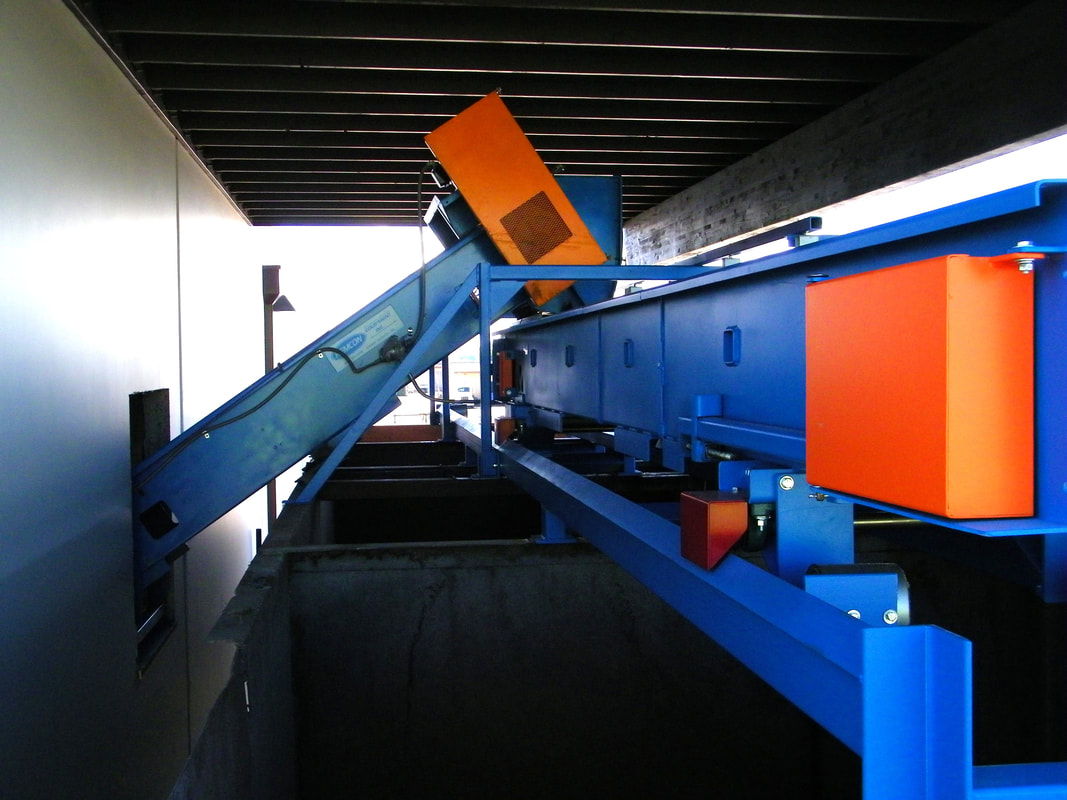
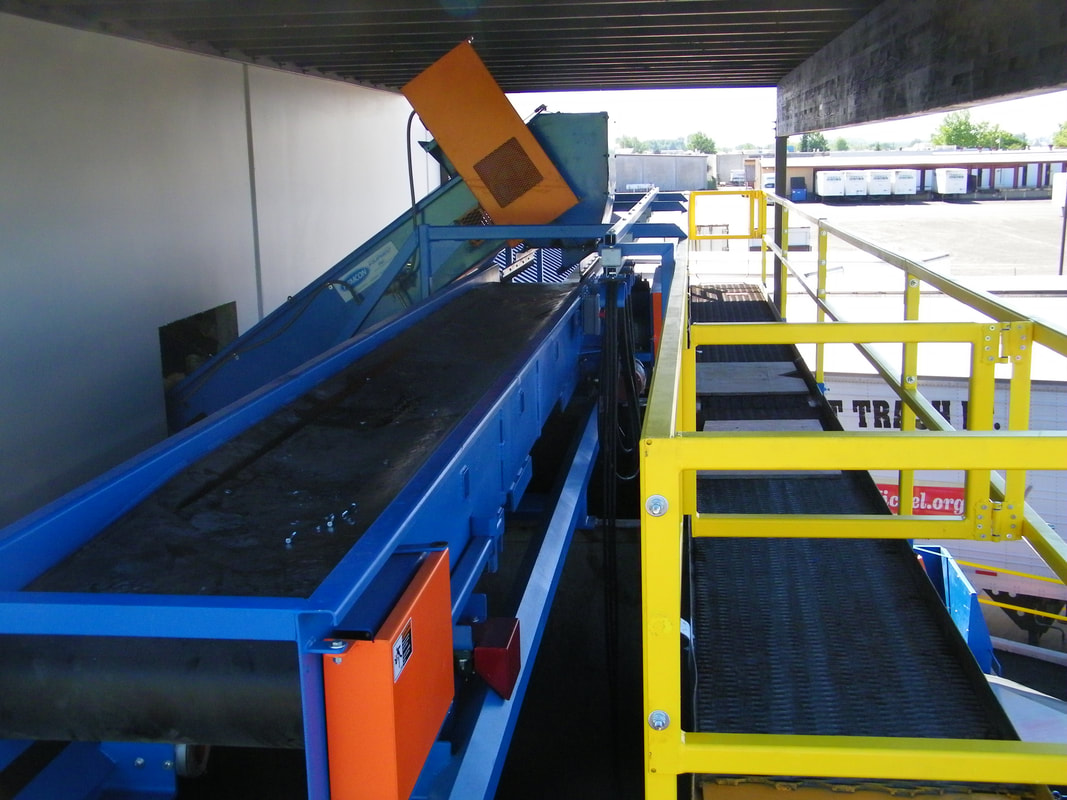
A shuttle conveyor is a belt conveyor mounted on a traveling carriage, with a belt that can run in both forward and reverse directions. Because both the carriage position and the belt direction can change, a single conveyor can deliver material precisely to multiple discharge points — a row of bins, bunkers, or stockpiles — instead of one fixed spot. The shuttle carriage moves back and forth along the length of the run, stopping at prescribed locations to fill each position in turn. That travel is what makes a reversing shuttle conveyor especially useful for applications that require storing materials in different piles or bins without the need for multiple systems.
Benefits of Shuttle Conveyors
- Increased flexibility. The ability to move in both directions allows these conveyors to serve multiple destinations, reducing the need for additional conveyors.
- Efficient use of space. One shuttle conveyor can serve multiple storage bins, reducing floor space requirements and simplifying your material handling setup.
- Custom designs. At Remcon, we can design a system to meet your exact specifications, including size, capacity, and discharge points.
What Materials Do Shuttle Conveyors Handle?
A shuttle conveyor earns its keep wherever one incoming stream has to be split across several storage positions. In recycling and processing plants, that typically means:
- Compost & ground green waste — spreading ground organics across curing bunkers or bays so each batch can be worked and aged separately.
- Hog fuel & biomass — distributing wood chips and hog fuel along a row of fuel storage bunkers ahead of the boiler infeed.
- Glass cullet — filling cullet bunkers by color or grade downstream of glass cleanup, keeping loads separated for market.
- MRF commodities — dropping sorted paper, cardboard, and containers into storage bunkers until there is enough of each to bale.
These are abrasive, dusty, sometimes wet materials — which is why the shuttle track is designed to shed debris and the wheels carry extra tolerance rather than running on a precision rail that grit would foul.
Bunker & Storage Distribution
The most common layout runs the shuttle above a row of bunkers or bins: a fixed conveyor feeds the shuttle, the carriage travels to the selected position, and the belt runs forward or reverse to discharge into the bunker below. As one bunker fills, the shuttle moves to the next. This is the heart of bunker and bin distribution in a recycling plant — one machine keeps a whole row of storage positions fed, in whatever order the operation needs.
Remcon builds the storage side of the system as well, so the discharge points and bin openings are designed to match from the start. Options include live floor bins — both walking floor and conveyor live floor styles — self-emptying sloped-floor bins, and bunker walls, storage bins & hoppers, including bunker walls with heavy-duty doors for front-loader push-through. Pairing the shuttle with live floor bins gives you distribution in and metered out-feed in the same footprint.
Features of Remcon Shuttle Conveyors
- Shuttle drive is a Dodge Tigear 2 gear reducer with brake motor to stop shuttle travel in prescribed locations.
- Shuttle wheels ride on heavy-duty steel angle track designed to shed debris, for smooth rolling. Shuttle wheels are modified "V" groove, with extra tolerance to prevent binding due to variations in track alignment.
- Shuttle track end stops are heavy-duty rolled conveyor belt that provide heavy, but soft, stops at each end of travel — a back-up stop for the brake motor.
- Remcon festoon cable system provides power to the belt and shuttle motors as well as E-stop cable switches. This design is extra-heavy duty and made from easily maintained and commonly available parts.
Options Available
- Complete control systems to move and stop the shuttle at desired locations.
- Complete support structures, with maintenance catwalks with guardrail, ladders, and more.
- Bunker walls or bins for the shuttle conveyor to feed into, such as live floor bins — both walking floor and conveyor live floor types.
- Bunker walls with heavy-duty doors for front-loader push-through.
- Self-emptying, sloped-floor bins.
Shuttle Conveyor Specifications
Every Remcon shuttle conveyor is built to order, so the hard numbers — travel length, belt width, capacity — are set by your bunker row and your material rather than a catalog page. The design standards below are what those numbers get built on.
| Specification | Remcon standard |
|---|---|
| Travel length | Sized to the bunker or bin row — quoted per job |
| Belt width & capacity | Matched to the material and feed rate — quoted per job |
| Shuttle drive | Dodge Tigear 2 gear reducer with brake motor to stop the shuttle in prescribed locations |
| Wheels & track | Modified V-groove shuttle wheels with extra tolerance, on heavy-duty steel angle track designed to shed debris |
| End stops | Heavy-duty rolled conveyor belt stops — a heavy but soft back-up stop for the brake motor at each end of travel |
| Power delivery | Remcon festoon cable system for belt and shuttle motors, plus E-stop cable switches — made from easily maintained, commonly available parts |
| Controls | Complete control systems to move and stop the shuttle at desired locations — optional |
| Support structure | Complete support structures with maintenance catwalks, guardrail, and ladders — optional |
| Storage | Bunker walls, live floor bins, and self-emptying sloped-floor bins available to complete the system |
Shuttle Conveyor FAQ
What is a shuttle conveyor?
A shuttle conveyor is a belt conveyor mounted on a traveling carriage, with a belt that can run in both forward and reverse directions, so one conveyor can deliver material to multiple discharge points. The carriage moves back and forth along a fixed track, stopping at prescribed locations to fill a row of bins, bunkers, or stockpiles without the need for a separate conveyor at each position.
How does a shuttle conveyor distribute material to multiple bins?
The shuttle carriage travels along heavy-duty steel angle track until it reaches the selected bin, where a gear reducer with brake motor stops it in the prescribed location; the belt then runs forward or reverse to discharge into that bin. As one bin fills, the shuttle moves to the next position. Remcon can supply complete control systems that move and stop the shuttle at the desired locations, and a festoon cable system powers the belt and shuttle motors through the full length of travel.
Can Remcon supply the bins and bunkers the shuttle conveyor feeds?
Yes. Remcon builds the storage side of the system as well — bunker walls, live floor bins in both walking floor and conveyor live floor styles, self-emptying sloped-floor bins, and bunker walls with heavy-duty doors for front-loader push-through. Supplying the shuttle conveyor and the storage together means the discharge points and bin openings are designed to match from the start.
How much does a shuttle conveyor cost?
Every Remcon shuttle conveyor is custom designed and quoted per job, so there is no set price. Cost is driven by travel length, belt width, the number of discharge points, the control system, and the support structure — catwalks, guardrail, and ladders. Tell us the material, the bins it needs to reach, and the travel length, and we will quote it. Call (509) 244-9439.
Custom Designed and Fabricated
We specialize in custom designed and fabricated equipment and can work with you to design a solution that will work well for your needs. Every shuttle conveyor is designed and fabricated at our Airway Heights (Spokane), Washington shop, then shipped and installed nationwide. Contact us to discuss options or to get a quote.
Contact us to discuss →