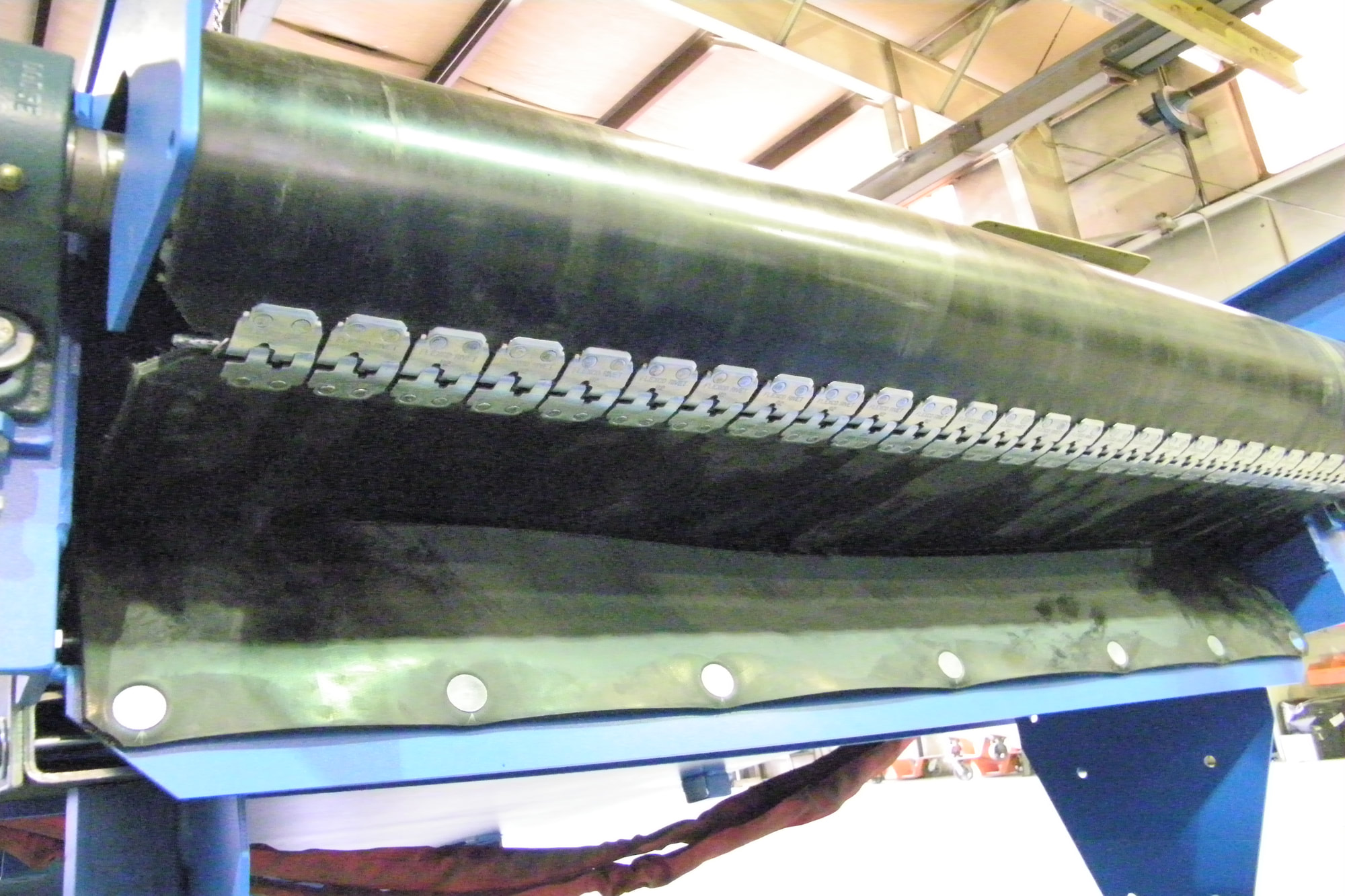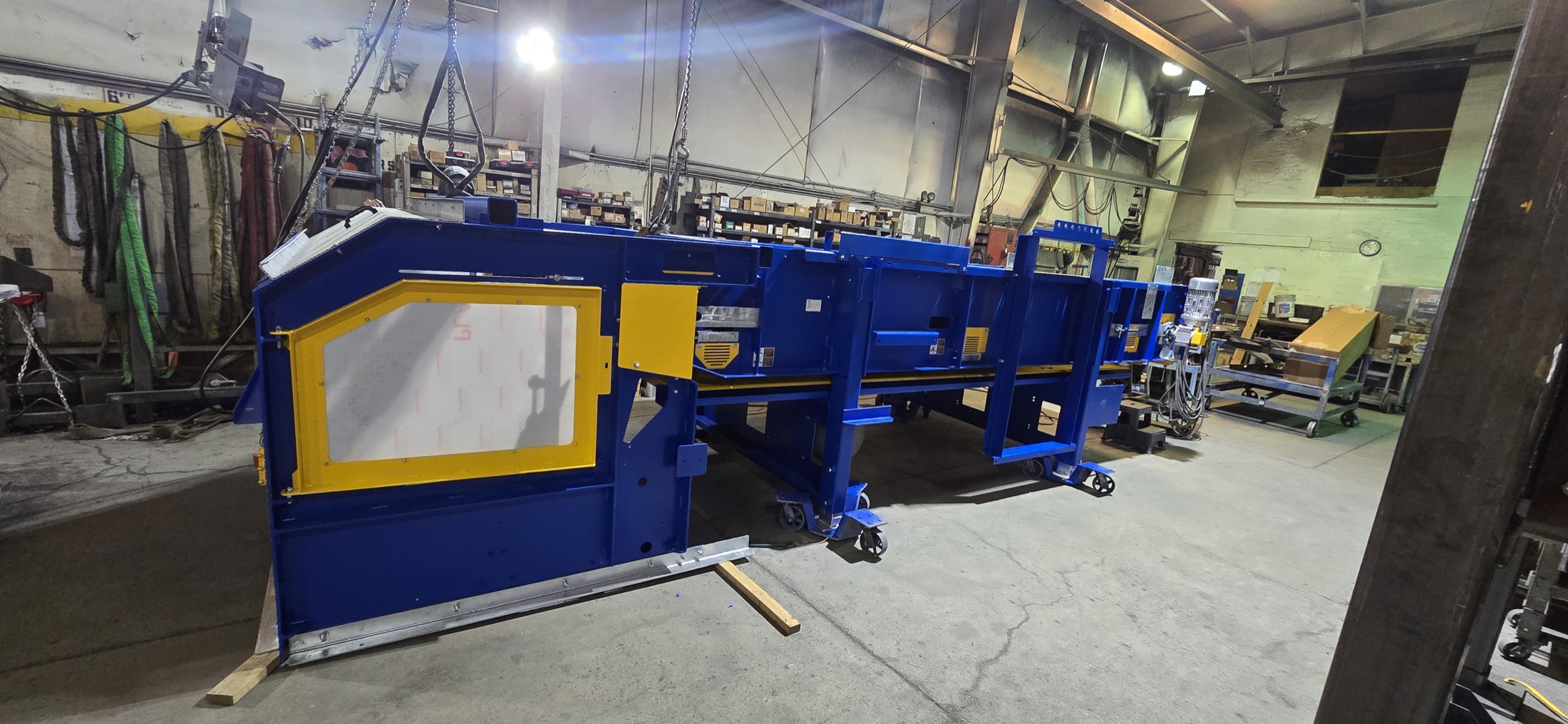
Remcon can build multiple different styles of conveyors, depending on what would work best for each application. The entries below describe each type of conveyor Remcon offers, with links to a full page on each. Please don't hesitate to contact us if you have any questions or need help deciding which type of conveyor might work for your application.
Chain / Chain Belt Conveyors
Chain conveyors use heavy chain mounted to both sides of a belt to pull the belt around the conveyor. The belt is supported laterally by steel cross members bolted to the underside of the belt and attached to the chain. This includes drag chain, roller chain, combo rubber/PVC roller chain belts, and steel pan roller chain belt conveyors.
All chain conveyor styles →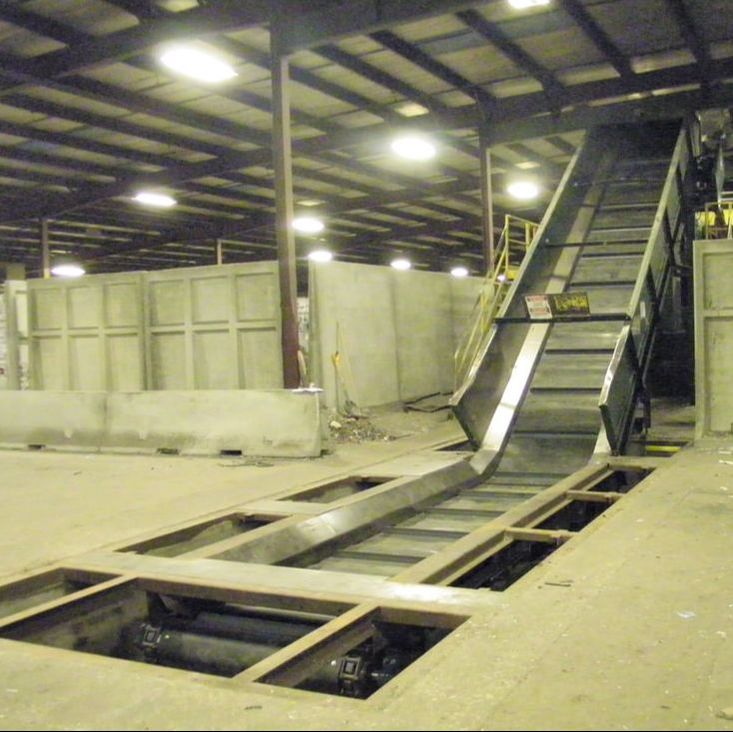
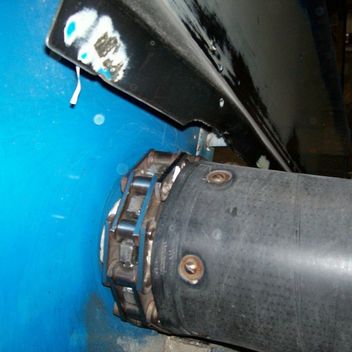
Drag Chain with Rubber or PVC Belting
The most basic type of chain belt conveyor. The chain lies flat on its side as it slides on tracks made of angle iron with UHMW wear surfaces, to reduce friction. The chain belt is guided around both ends of the conveyor on sprockets. The sprockets at the discharge end of the conveyor grab the chain as the shaft and sprockets are turned by a motor with a reducer.
More on drag chain belt conveyors →Roller Chain with Rubber or PVC Combination Belt
Also called a "combo belt." This type of belt is similar to a drag chain belt, except the chain has steel rollers built into each link which roll on rail tracks instead of sliding. This reduces the drag of the belt as it travels along the conveyor.
Roller Chain with Steel Pans (Steel Belt)
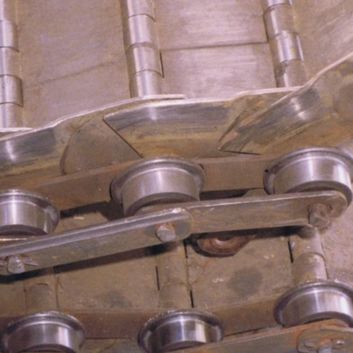
The same as the roller chain with rubber belt, except steel panels are substituted for the rubber belting. Remcon offers a variety of steel belt options; contact us to discuss which configuration would work best for your needs.
More on roller chain conveyors →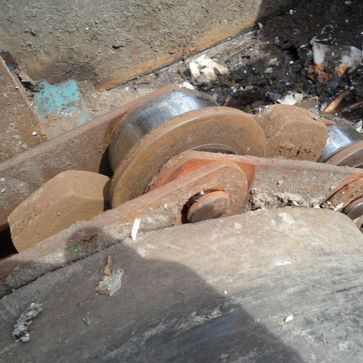
Drag Chain with Steel Flights (Beltless)
This style of drag chain conveyor is simple and robust in that there is no actual belt surface to become punctured or bent. It is similar to a single-strand drag chain conveyor, but employs two parallel strands of chain connected with steel cross members. The cross member carries the material along as it slides on top of a flat steel surface, either horizontally or uphill. A common choice for conveying metal.
More on drag chain with steel flights →Single-Strand Drag Chain for Bulk Materials
The most simple form of drag chain conveyor: a single, wide strand of chain slides along a flat wear surface, dragging along with it loose material that is fed into the conveyor. Depending on the design, the chain can move only the material that sits inside the links of the chain, or the material that sits both inside and on top of the chain — sometimes called "en-mass conveying." These conveyors often employ some type of paddle or wing attachment to help move the material along, but they are not always required, depending on the application.
Discuss single-strand drag chain with us →Chain Conveyors for Bulk Containers
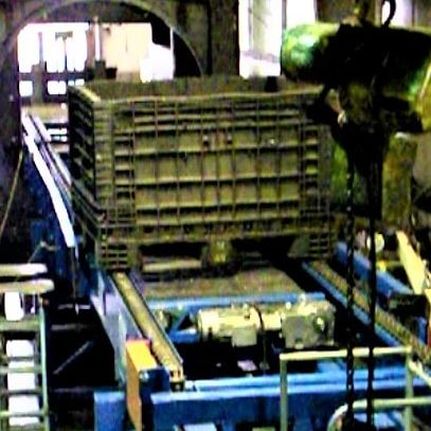
A uniformly shaped object such as a bin or pallet sits on two strands of chain. Heavy-duty chain rides on its edge on a UHMW wear surface as each strand loops around the conveyor, with sprockets at each end. The two strands are not connected to each other, but are pulled along simultaneously by a motor connected to the drive shaft at the discharge end. The bin or pallet is pulled along the conveyor as it rides on top of the chains.
These conveyors can be built in many different styles, and can be arranged and set up with sensors to allow automatic staging, conveying, dumping, raising, and lowering of bins to different locations in a plant.
More on bulk container conveyors →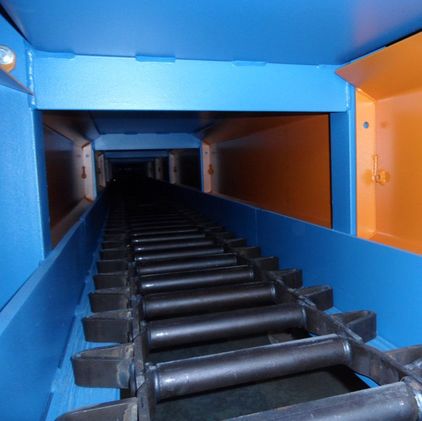
Heavy-Duty Roller Conveyors
Roller conveyors use heavy-duty rollers to allow heavy products to be moved — by hand, by powered rollers, or gravity-fed along a downhill slope.
More on roller conveyors →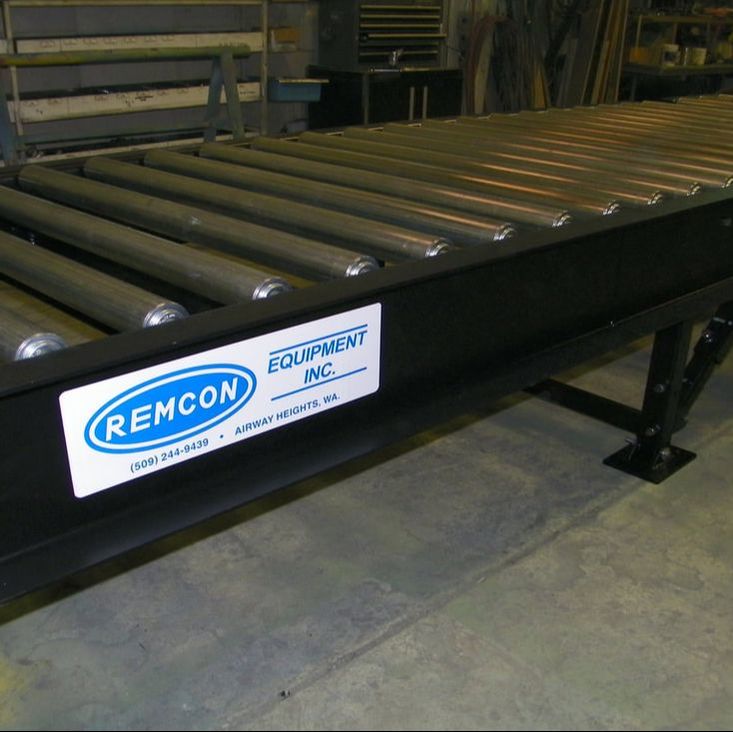
Slider Bed Conveyors
Slider bed conveyors employ a rubber or PVC belt which is driven around the conveyor by the friction of the belt on the drive pulley. The belt slides on steel slats, instead of idler rollers, making for fewer moving parts to wear out and replace. Remcon's simple but versatile slider bed conveyor design often allows this type of conveyor to be used in place of other more complicated or more expensive types of conveyors.
More on slider bed conveyors →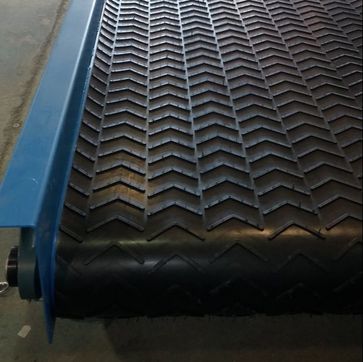
Troughing Idler Conveyors
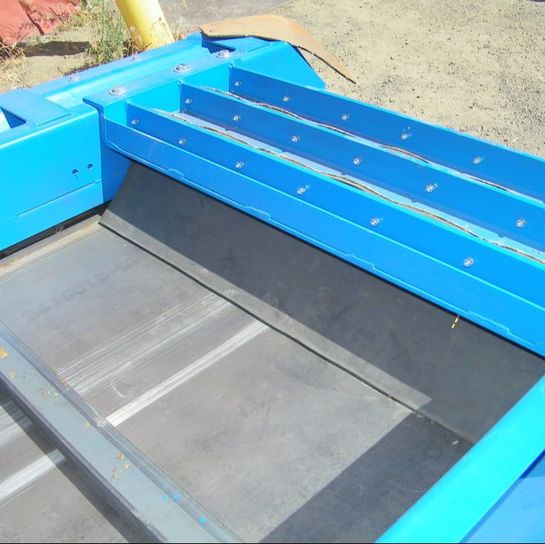
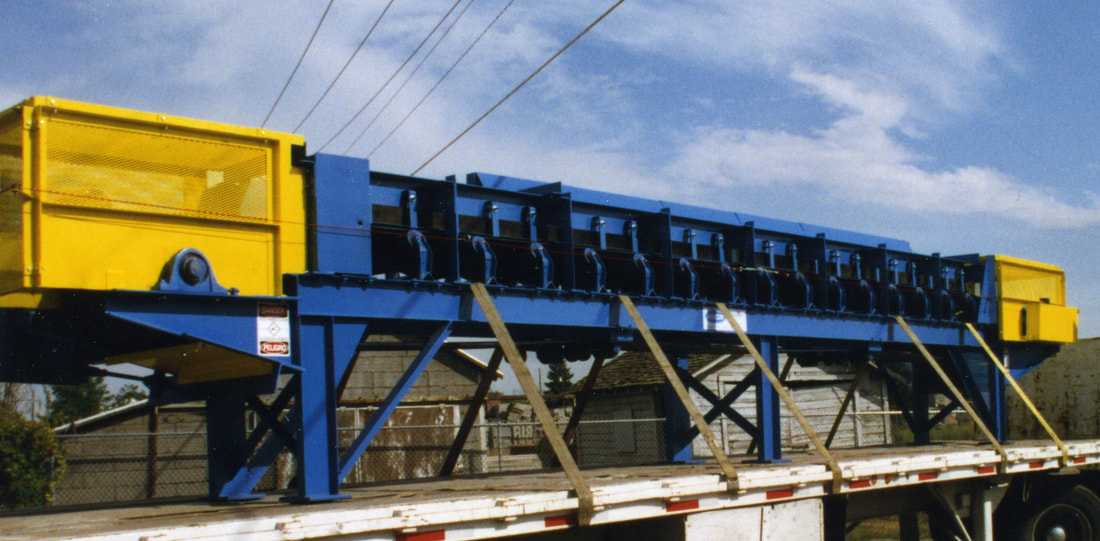
Troughing idler conveyors employ a rubber or PVC belt which rides on idler rollers mounted in a "U" shape, to help contain loose material on the belt. These conveyors are typically used to carry gravel or dirt, especially when conveying long distances, to maximize efficiency.
More on troughing idler conveyors →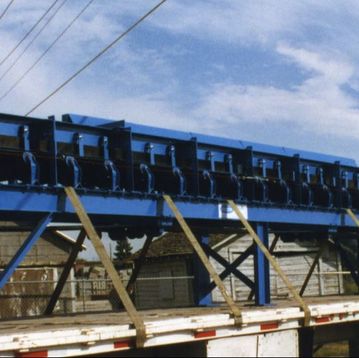
Highlights & Benefits of Remcon Conveyors
Below are some of the special features that apply to most, if not all, Remcon conveyors. Many more special features pertaining to each specific conveyor or conveyor type can be found on the page for each type of conveyor.
Cleat Options
Conveyors (as well as pulley diameters) are designed to accept various cleat designs, such as chevron or regular style cleats, up to 2" high — or even taller, on some conveyors. If it is decided to add cleats after the conveyors are installed, heavy-duty rubber bolt-on cleats may be added easily without modifying the conveyor.
Common Components
Remcon conveyors are all built from components widely distributed throughout the USA, providing quick and easy service if needed from just about anywhere in the country.
Conveyor Alignment
Remcon conveyors are shop fabricated in the longest sections practical (up to 40 ft.). Adjoining sections are aligned accurately with each other in the shop as they are fabricated. The entire conveyor is aligned again (and leveled) during installation, to prevent the belt from wandering and wearing into the side of the conveyor.
Self-Cleaning Return Pans
Remcon conveyors are designed with pans to support the return belt instead of idler rolls. This design has been used by Remcon successfully since 1978. The return belt pans offer several advantages:
- Reduced maintenance — The need for idler rollers and the maintenance they require (greasing, tracking, cleaning) is eliminated, because the return belt and cleats slide in the smooth, one-piece return pan.
- Safety — The return belt and cleats are completely guarded by the return pan. Because the pan is an integral part of the conveyor, a serious safety problem is eliminated. There are no pans that must be removed for cleaning, which eliminates the possibility of workers failing to close or re-install pans and exposing dangerous pinch points. It also eliminates the problem of removing pans that have become filled with a heavy load of debris.
- Cleanliness — All carryover from the head pulley, plus any debris that falls off anywhere along the return belt, is captured in the return pan and dragged to clean-out openings along the length of the conveyor or a collection area at the in-feed end. Belts with chevron cleats only, and smooth belts, are to have heavy-duty rubber cleaner cleats that drag debris out of the return pan. On sorting conveyors, these cleats are low profile and widely spaced (10 to 40 feet) to prevent interference with sorting.
- Cleats without notches — No return rollers are needed, eliminating the need for disks that have to line up with notches in belt cleats, and eliminating the risk of damage if one of these disks slips out of alignment. It also eliminates any leakage caused by material sliding down the carrying belt through the notches.
- Versatility — Return pans offer more options for adding cleats (see "Cleat Options" above).
- Ease of belt maintenance and installation — Because the belt is supported by the pan the full length of the conveyor (rather than sagging between rollers), no tools are required to pull the ends of the belt together when connecting the belt. Pulley removal and installation is much easier, also.
Drive Method — Parallel Gear, Shaft-Mounted Torque Arm Reducers (Dodge Torque Arm II)
Remcon's preferred conveyor drive method uses a Dodge Torque Arm II reducer driven via separate motor, v-belts, and sheaves. These reducers have been used almost exclusively in the sand, rock, gravel, and mining industries for many years, and are well proven. Remcon has used them since 1990, with good success. The new generation has been engineered throughout with features designed to improve performance, extend service life, and reduce maintenance. Remcon's normal configuration — reducers driven by a separate motor via v-belts using different sheave combinations — allows for additional speed reduction. The advantages of the Dodge Torque Arm II shaft-mount reducer with v-belt drive:
- Low maintenance — There are no chains to oil, tension, or shorten and reconnect.
- Ease of adjustment — Rather than moving the entire gearbox and motor to adjust chain tension, the Dodge Torque Arm II reducer only requires loosening two lock nuts and turning the turnbuckle by hand.
- Fewer wear parts — There are no sprockets or chain to wear out. Although v-belts will wear out, they commonly do not wear out until they are protecting the conveyor from jamming (see the following item), are inexpensive, and are easy to replace. V-belt sheaves last much longer than chain sprockets and chain.
- Jamming protection — They eliminate the need for mechanical shear pins. The motor drives the reducer by v-belt(s); if the conveyor jams, the v-belt slips, preventing damage from the jamming. As the v-belt slips, it typically makes a loud squealing noise that draws attention to the problem. If the conveyor is not turned off, the v-belt will eventually be ruined, and there will be nothing driving the jammed conveyor. The v-belt is the cheapest part in the drive to replace. Replacing the belt involves opening the hinged belt guard door, loosening the turnbuckle, and slipping the new belt on. If the conveyor is prone to jamming (for example, wrong product or too much product), the v-belt can be kept looser than normal to minimize the potential for damage. In the years we have used these reducers, we are unaware of any Remcon conveyor equipped with them that suffered damage resulting from jamming. As additional back-up protection, an electronic shear pin may be added to the electrical system.
- Parallel gears — The gears are parallel, rather than right angle. Parallel gears are more efficient and produce less friction.
- Operating and maintenance convenience — When working on a conveyor (maintenance, un-jamming product, or diagnosing problems), there is often a need to move the belt a short distance forward or backward. This is impossible electrically, since the power should be locked out at this time. With a shaft mount reducer, it can be accomplished easily and safely without power by turning the spokes on the input sheave by hand.
- Excellent availability — The Dodge Torque Arm II reducers are so commonly used in other industries that they are quite often in stock at many local dealers, and are almost always available somewhere in the country. Other brands (Link, Browning, etc.) may also be substituted without modification.
- Separate motor — The motor is mounted separately from the reducer and connected only by v-belts. Any brand of motor can be used, and a motor breakdown does not affect the reducer, or vice-versa.
- Ease of changing reduction ratios — Reduction ratios of up to 5 to 1 are easily obtained from the motor-to-reducer v-belts and sheaves. These ratios are easily changed by swapping out sheaves, which is more difficult and expensive with chain and sprockets.
Remcon Belt Take-Ups
Remcon's cantilevered, telescoping tube style take-ups with manual screw adjustment offer the following advantages:
- Cleaning access — The take-up frame is positioned to provide access to the area between the upper and lower belts, for ease of cleaning and inspecting the tail pulley.
- Replaceable parts — Remcon take-ups are comprised of separate, individual components that can be easily replaced as they wear out. The bearings bolt on separately and are the commonly available pillow block style. The threaded working parts of the take-up are separate and easily removed, and are commonly available from local fastener or hardware stores.
- Take-up travel — Generous length of take-up travel (10" on the shorter conveyors, up to 18" on the longest). On slider bed style conveyors, the belt will be cut so that the majority of the take-up travel is used to make the belt looser, for ease of belt installation, repair, and replacement. Since good quality belts with polyester carcasses have virtually no stretch after initial tensioning (and in some cases will even shrink slightly), not as much take-up travel is needed for making the belt tighter as the belt is used.
- Ease of adjustment — Belt tracking and tension adjustments are made with one wrench, with no need to loosen and re-tighten the bearing attachment bolts. The moving parts of the take-up have generous amounts of clearance, to prevent binding in the frame or against the bearings (side load) as the take-up moves through its full range.
- Versatility — Remcon take-ups will accommodate almost any brand of pillow block style bearings (the most common style of bearing).
Further Reading
Guides from the people who design and weld this equipment:
- Slider Bed vs Roller Bed Conveyor: How to Choose — friction, maintenance, and which bed suits your material
- How to Buy a Conveyor: Questions to Ask and Quotes to Distrust — questions to ask, and what a too-cheap quote left out