
Remcon can fabricate custom heavy-duty roller conveyors specifically designed for your application. We build non-driven roller conveyors (for example, gravity fed) and driven or partially driven roller conveyors.
We may not specialize in off-the-shelf, light-duty roller conveyors. However, people come to us when they need something more heavy-duty or more custom than other companies provide.
Remcon can design a roller conveyor for your application using off-the-shelf parts on a custom-built frame. If standard off-the-shelf parts will not work, we can replace some or all of the parts or custom-build them.
Typical locations are warehouses, manufacturing facilities, and distribution centers: any place where pallets, crates, and other heavy unit loads move between processes. One example is product moving down an original equipment manufacturer (OEM) production line.
Get a quote for a heavy-duty roller conveyor →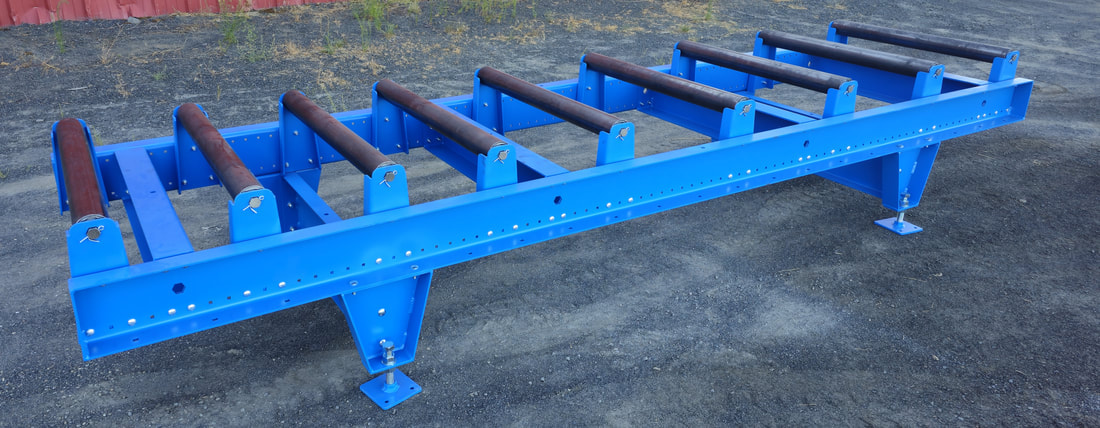
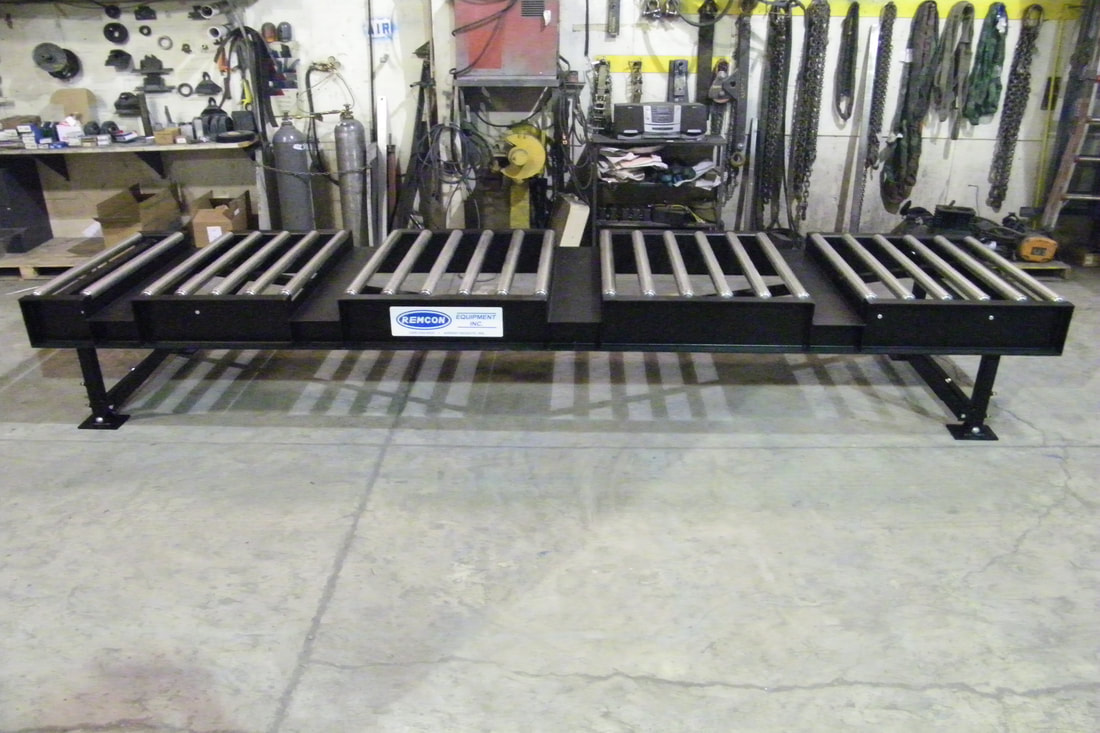
Gravity Roller Conveyors (Non-Driven)
A gravity roller conveyor has no motor. The load rolls on free-turning rollers. A slight downhill pitch, a push, or the forklift that set the load down moves the load. There is nothing to power, but the rollers must keep turning freely under the full weight of the load. Full weight on the rollers is exactly where light catalog conveyors fail. Remcon builds the frame and rollers to the load, so heavy pallets and palletized product roll instead of stalling.
Driven & Partially Driven Roller Conveyors
A driven roller conveyor powers some or all of its rollers. The powered rollers move the load along a level run without a push. A driven roller conveyor is used for loads that are too heavy to move by hand, or where travel has to be controlled and repeatable. A partially driven conveyor powers only the sections that need it. Gravity moves the load through the other sections. Drive type and horsepower are sized to the load and the duty cycle, and quoted per job.
Advantages of Remcon Heavy-Duty Roller Conveyors
Remcon roller conveyors are specifically designed to handle large and heavy materials, which makes them ideal for industries that handle substantial loads. A key feature of these conveyors is the clearance between the rollers. The clearance allows forklift forks, hoist straps, or crane chains to pass safely beneath the load.
The clearance between the rollers makes loading and unloading easy. It also minimizes the need for additional lifting equipment and reduces the risk of damage to both materials and equipment. The spacious clearance lets the conveyor handle bulky crates, pallets, and other large items efficiently.
Roller conveyors are ideal for warehouses, manufacturing facilities, and distribution centers. Roller conveyors simplify workflows and improve overall productivity in material handling operations. Businesses can customize roller conveyors to handle large loads and to make sure that there is enough clearance for loading equipment. With these customizations, businesses can improve their efficiency and effectiveness in transporting heavy materials.
What Makes a Roller Conveyor Heavy-Duty?
"Heavy-duty" is printed on a lot of catalog pages. In practice, it depends on the construction (what carries the weight, and what happens when a forklift sets a load down harder than planned):
| Element | Light-duty catalog conveyor | Remcon heavy-duty roller conveyor |
|---|---|---|
| Frame | Light-gauge formed rail, bolted together | Custom-built welded steel frame, designed for the load and the loading method |
| Rollers | Thin-wall tube on light axles | Matched to the load: from drop-in, spring-loaded idler rollers up to custom-built rollers |
| Bearings | Pressed into the roller ends | Up to pillow block bearings bolted to the frame for the heaviest loads |
| Roller spacing | Fixed catalog pitch | Matched to the load footprint, so the load is always supported by multiple rollers |
| Loading | Hand-placed items | Forklift, hoist, or crane: roller clearance and fork pocket openings built in |
| Capacity | Catalog rating | Sized to the application, quoted per job |
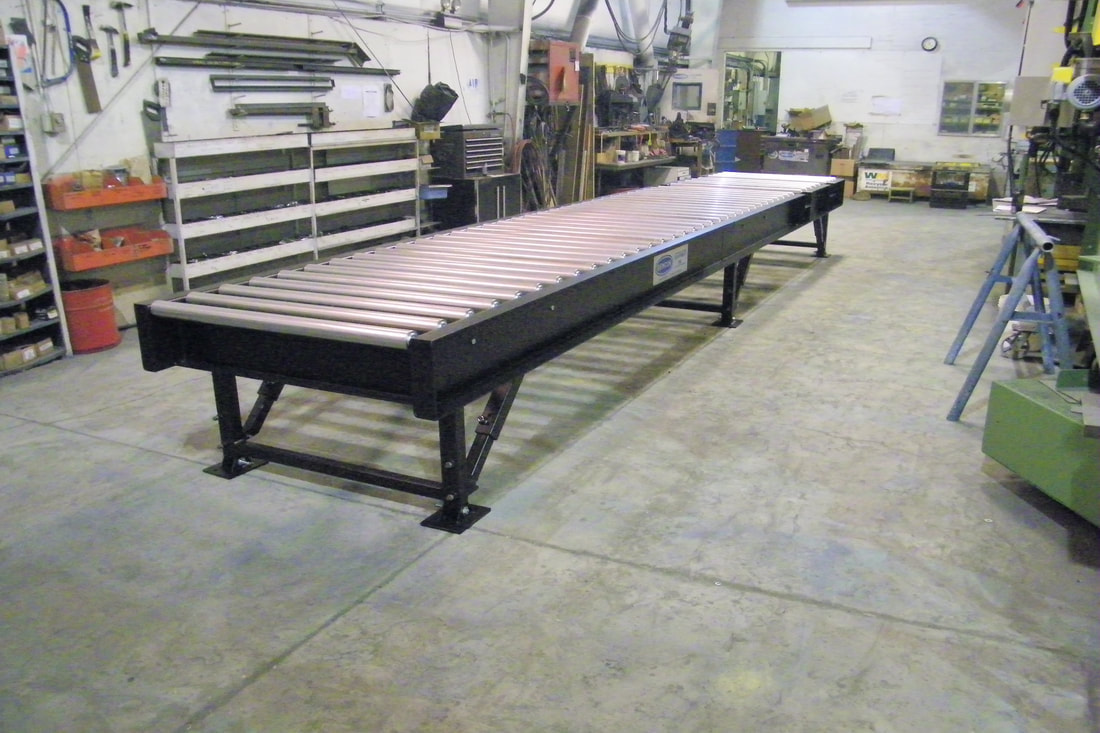
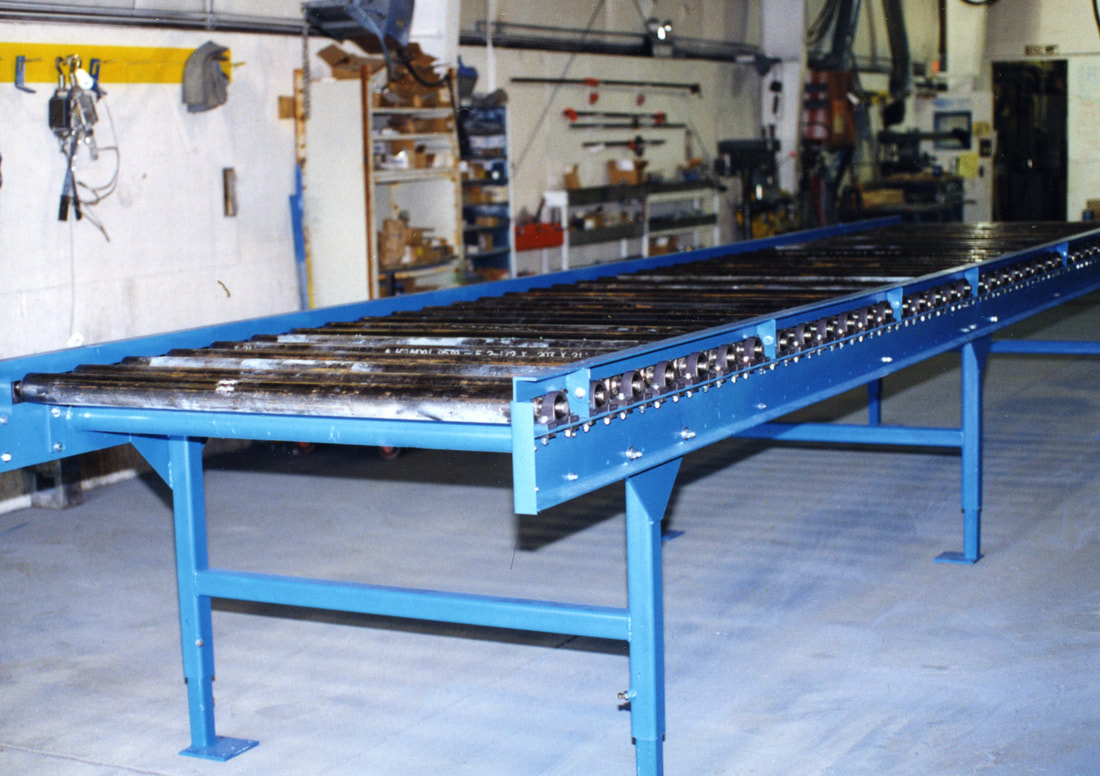
The two conveyors pictured above show the two ends of that range. One has drop-in, spring-loaded idler rollers. The other carries palletized concrete block on custom-built rollers on pillow block bearings.
Materials & Industries
Roller conveyors carry unit loads, which are items that arrive on forks rather than in bulk. Remcon has built roller conveyors for loads as heavy as palletized concrete block. This class of conveyor typically carries pallets, crates, and other large, heavy unit loads, including product moving down an OEM production line. Typical locations are warehouses, manufacturing facilities, and distribution centers: any place where heavy items move between processes without occupying a forklift for the whole trip.
Sample Drawing
A recent example is a roller chain belt conveyor that forms the floor of a live floor bin for a storage bunker. The drawing shows how a Remcon conveyor is laid out for a specific site.
Download the drawing (PDF) →Roller Conveyor FAQ
What is the difference between a gravity roller conveyor and a driven roller conveyor?
A gravity roller conveyor has no motor. The load rolls on free-turning rollers. A slight downhill pitch or a push moves the load. A driven roller conveyor powers some or all of the rollers, so loads move along a level run without a push. A partially driven conveyor powers only the sections that need it. Remcon builds all three, sized to the load.
How much weight can a roller conveyor handle?
Capacity depends on the roller construction, the bearings, the roller spacing, and the frame. Remcon sizes each conveyor to the actual load rather than to a catalog rating. Roller conveyors range from drop-in, spring-loaded idler rollers for general unit loads up to custom-built rollers on pillow block bearings. The custom-built rollers on pillow block bearings are for extra heavy loads such as palletized concrete block.
Can a roller conveyor be loaded with a forklift?
Yes. Remcon roller conveyors are designed with clearance between the rollers, so forklift forks, hoist straps, or crane chains can pass beneath the load. Customer-specified fork pocket openings can also be built into the frame. The frame itself is built to take forklift loading, not only the rolling weight.
How much does a custom heavy-duty roller conveyor cost?
Price depends on the load weight, the roller and bearing construction, gravity versus driven, the length, and how the conveyor will be loaded. For this reason, Remcon quotes each conveyor individually. Tell us the load, the item size, and how you will load it (forklift, hoist, or crane). Then we will quote it. Call (509) 244-9439.
We design and fabricate every Remcon roller conveyor at our Airway Heights (Spokane), Washington shop, then ship and install it nationwide.
We specialize in custom designed and fabricated equipment. We can work with you to design equipment that will work well for your needs. Contact us to discuss options or to get a quote.
Contact us →Further Reading
Guides from the people who design and weld conveyors:
- Slider Bed vs Roller Bed Conveyor: How to Choose. Friction, maintenance, and which bed suits your material.