
Shuttle conveyors are belt conveyors that travel. The carriage rolls back and forth on a fixed track and the belt runs forward or reverse, so one machine fills a whole row of bunkers, bins, or stockpiles instead of one fixed spot. Remcon designs and builds them for bunker filling in recycling plants, compost and biomass storage, and stockpiling — travel length, belt width, and capacity set by your layout rather than a catalog page.
What Is a Shuttle Conveyor?
A shuttle conveyor is a belt conveyor mounted on a traveling carriage, with a belt that can run in both forward and reverse directions. Because both the carriage position and the belt direction can change, a single conveyor can deliver material precisely to multiple discharge points — a row of bins, bunkers, or stockpiles — instead of one fixed spot. The shuttle carriage moves back and forth along the length of the run, stopping at prescribed locations to fill each position in turn. That travel is what makes a reversing shuttle conveyor especially useful for applications that require storing materials in different piles or bins without the need for multiple systems.
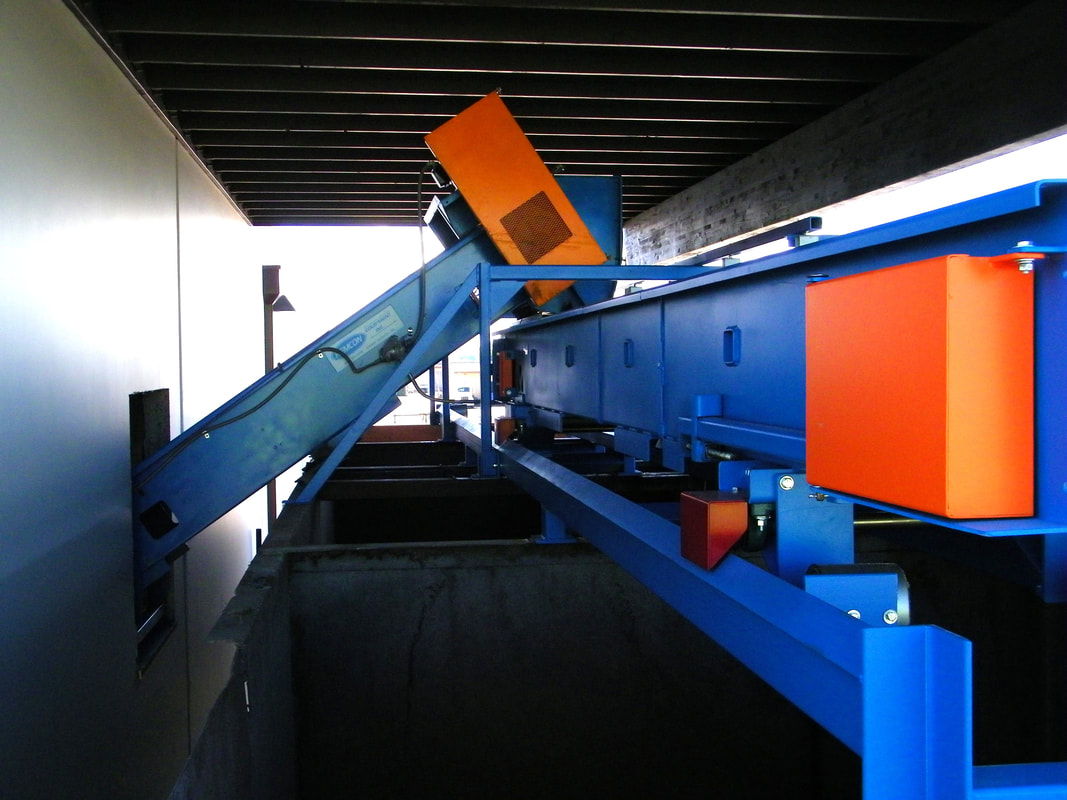
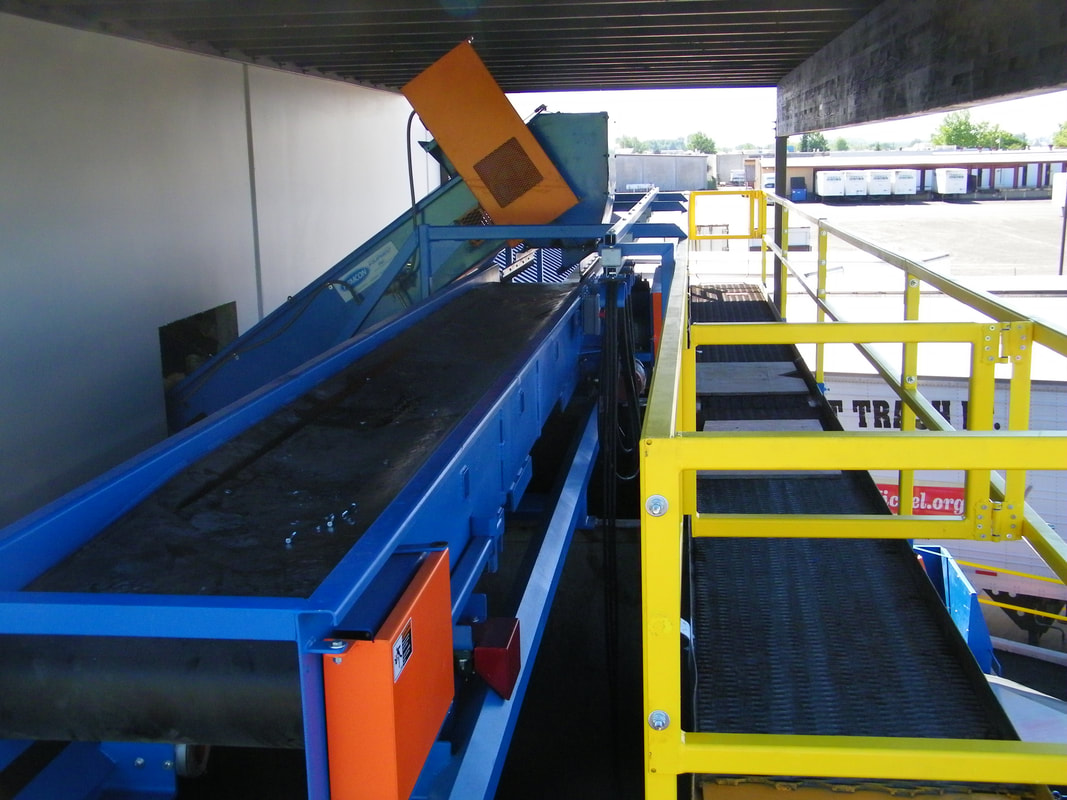
How a Shuttle Conveyor Works
A shuttle conveyor does everything a fixed conveyor does, plus three things a fixed conveyor never has to: move, stop where you tell it, and stay powered while it does both. Here is the machine, from the feed point down.
Feed point
Material comes off a fixed conveyor above the shuttle and drops onto the shuttle belt. That feed point does not move. The shuttle travels underneath it, so the incoming stream always lands in the same place no matter which bin is being filled. That fixed run is often a transfer conveyor.
The belt
What separates a shuttle belt conveyor from an ordinary one is that the belt runs both directions, so material can leave off either end of the carriage instead of only off the head. Belt width and capacity are matched to the material and the feed rate and quoted per job; across the Remcon conveyor line belts run from 12 to 72 inches wide. The belt is also the wear part on a machine handling glass cullet, hog fuel, or ground green waste, so it is the piece most likely to need attention first — Remcon supplies replacement conveyor belts for its own machines and for other brands.
Carriage and track
The conveyor — frame, belt, pulleys, drive — rides on a wheeled carriage that rolls along a fixed track set above the storage. Remcon builds that track from heavy-duty steel angle, shaped to shed debris rather than collect it. The wheels are a modified "V" groove cut with extra tolerance, so variation in track alignment does not bind the carriage.
Travel drive and stopping
A Dodge Tigear 2 gear reducer with a brake motor drives the carriage. The brake is the part that matters: it stops shuttle travel in prescribed locations, so the discharge lands over the position you picked and not past it. At both ends of the run, heavy-duty rolled conveyor belt serves as the end stop — heavy, but soft, and a mechanical back-up to the brake motor.
Power on a moving machine
Nothing that travels can be hard-wired in place. Remcon uses a festoon cable system: the cable hangs in loops from trolleys on a track and opens and closes as the carriage moves, feeding power through the full length of travel without dragging or stretching the conductors. It carries the belt motor, the shuttle motor, and the E-stop cable switches. It is the one part of the machine that bends every time the shuttle moves, which is why Remcon builds its festoon extra-heavy duty and out of easily maintained, commonly available parts.
Benefits of Shuttle Conveyors
- Increased flexibility. The ability to move in both directions allows these conveyors to serve multiple destinations, reducing the need for additional conveyors.
- Efficient use of space. One shuttle conveyor can serve multiple storage bins, reducing floor space requirements and simplifying your material handling setup.
- Custom designs. At Remcon, we can design a system to meet your exact specifications, including size, capacity, and discharge points.
Reversible Shuttle Conveyors
"Reversible" and "reversing" describe the belt, not the carriage. Every shuttle carriage travels both ways on its track. What reversible names is control over which direction the belt runs, so the machine is not restricted to which end material discharges from. That is how Remcon builds them: the belt runs forward and reverse. On a plant floor the machine is often just called a reversible conveyor, and that is accurate as far as it goes: a reversible conveyor is any belt that runs both ways, and a shuttle is a reversible conveyor mounted on a traveling carriage.
Two things fall out of that. First, the feed point does not have to sit at one end of the row. A fixed feed conveyor can drop material over the middle of the bins, and the shuttle throws it left or right from there, so the layout can follow the building instead of the machine. Second, the conveyor does not have to be as long as the storage it serves. Because a reversible shuttle conveyor discharges off either end, it generally spans about half the row and covers the rest by traveling.
That pays off most when:
- bins or bunkers sit on both sides of where material enters the building;
- one shuttle has to serve two separated groups of storage rather than one continuous row;
- positions change often and you would rather flip belt direction than drive the full run for every switch;
- you are building a stockpile and want to lay it in from either end.
A belt that only ran one way would commit every discharge point to the same end of the machine, and the building would have to be laid out around that.
What Materials Do Shuttle Conveyors Handle?
A shuttle conveyor earns its keep wherever one incoming stream has to be split across several storage positions. In recycling and processing plants, that typically means:
- Compost & ground green waste — spreading ground organics across curing bunkers or bays so each batch can be worked and aged separately.
- Hog fuel & biomass — distributing wood chips and hog fuel along a row of fuel storage bunkers ahead of the boiler infeed.
- Glass cullet — filling cullet bunkers by color or grade downstream of glass cleanup, keeping loads separated for market.
- MRF commodities — dropping sorted paper, cardboard, and containers into storage bunkers until there is enough of each to bale.
These are abrasive, dusty, sometimes wet materials — which is why the shuttle track is designed to shed debris and the wheels carry extra tolerance rather than running on a precision rail that grit would foul.
Shuttle Conveyors for Rock, Sand, and Aggregate
Everything on that list is a recycling plant. As a machine type, shuttle conveyors also fill surge and product bins in crushing plants, aggregate bins under batch plants, and enclosed storage buildings. The distinction is between machine and specification: carriage, reversing belt, track, brake-motor travel drive and festoon do the same job whatever is on the belt, and most of the numbers underneath them change for crushed rock. Remcon's fabrication in rock and minerals — a silver mine's heavy-duty troughing idler conveyor, sand conveyors, a magnetite separation job — sits on the quarry and aggregate conveyors page.
Weight is what the carriage feels
The machine has already met rock's weight class. Glass cullet, one of the materials above, sits in the same bulk density band as crushed limestone and broken granite, so a shuttle filling cullet bunkers already carries a belt loading a crushed-stone plant would recognize. Compost, hog fuel and loose MRF commodities are a fraction of that, and that span is what the specification has to cover. Live load runs into wheels, track, runway beam and the steel under all of it, concentrated into rails in a way a static frame never is. The standing figure is not the design case either: a starting, reversing carriage adds to it. Those numbers get recalculated, not carried across from a lighter machine.
The load zone travels with the machine
On a fixed conveyor the load zone stands still; on a shuttle the feed point stands still and the frame accelerates underneath it. Impact support and skirting copied off a static drawing leak as soon as the belt runs the other way, because skirt sealing and belt cleaning are both directional. That spillage does not land on the floor. It lands on the track, and rock on a rail is what puts a carriage on the ground. Which is why the debris-shedding track and the extra tolerance in the V-groove wheels matter more with rock, not less. Lump size and drop height set the rest: cushion-disc impact idlers, an impact bed, skirtboard length. Same decisions as on a crusher discharge conveyor, against a frame that is also moving.
A reversing belt is harder to keep straight
Reversing is the point of the machine, and it costs something. Martin Engineering's tracking work says it plainly: when the belt reverses, the carrying side of the conveyor changes from being pulled to being pushed, and a belt being pushed is inherently more unstable and more difficult to train. Worse, a conventional pivoting trainer that steers the belt straight one way will steer it off the other. Under rock a wandering belt is spillage, and spillage is the track problem above. Trainers built for reversing service, squared idlers and belt cleaning that works both ways belong on the specification, not the punch list. Cover grade, trough angle and idler class go the same way — see troughing idler conveyors and the troughing idler selection guide.
Bunker & Storage Distribution
The most common layout runs the shuttle above a row of bunkers or bins: a fixed conveyor feeds the shuttle, the carriage travels to the selected position, and the belt runs forward or reverse to discharge into the bunker below. As one bunker fills, the shuttle moves to the next. This is the heart of bunker and bin distribution in a recycling plant — one machine keeps a whole row of storage positions fed, in whatever order the operation needs.
Remcon builds the storage side of the system as well, so the discharge points and bin openings are designed to match from the start. Options include live floor bins — both walking floor and conveyor live floor styles — self-emptying sloped-floor bins, and bunker walls, storage bins & hoppers, including bunker walls with heavy-duty doors for front-loader push-through. Pairing the shuttle with live floor bins gives you distribution in and metered out-feed in the same footprint.
Shuttle Conveyor vs. Tripper Conveyor vs. Multiple Fixed Conveyors
There are three common ways to get one incoming stream into several storage positions. The right one depends on how long the storage row is and how much steel you are willing to put in the building.
A shuttle conveyor moves the whole conveyor. The carriage travels along the bin row on a track, and the reversing belt discharges off either end.
A tripper conveyor leaves the conveyor where it is and moves the discharge instead. A belt tripper is a carriage carrying pulleys arranged so the belt is lifted and material is thrown into a short chute, which directs it into the bin or pile below. It rides the conveyor's own structure and can be parked in one spot or run continuously to build a layered pile. The catch is length: the carrier conveyor has to span the full storage row. A reversing shuttle does not — because it discharges off either end, it generally spans about half the row and travels for the rest, so there is less conveyor over the same storage.
Multiple fixed conveyors put a dedicated conveyor over every position and use gates, diverters, or chutes upstream to decide which one runs. Nothing travels, which is the appeal. Every position is another drive, another belt, and another thing to maintain, which is the price.
| Factor | Shuttle conveyor | Tripper conveyor | Multiple fixed conveyors |
|---|---|---|---|
| What moves | The whole conveyor, on a track | A tripper carriage riding the conveyor structure | Nothing — the stream is diverted upstream |
| Conveyor length | Generally about half the storage row — the belt reverses, the carriage covers the rest | Must span the full length of the storage | Grows with every position added |
| Discharge points | Any position the controls stop at, off either end of the belt | Any point the tripper can reach along the carrier belt | Fixed — one per conveyor |
| Drives to maintain | One belt drive, one travel drive | Carrier belt drive, plus a travel drive on the carriage in most traveling designs | One per conveyor |
| Usual fit | Bunker and bin rows inside a plant | Long stockpiles and silo rows | A small number of permanent destinations |
Remcon builds shuttle conveyors and the storage they feed. Which of the three suits your building is worth working out before anything gets welded — tell us the row length and the number of positions.
Features of Remcon Shuttle Conveyors
- Shuttle drive is a Dodge Tigear 2 gear reducer with brake motor to stop shuttle travel in prescribed locations.
- Shuttle wheels ride on heavy-duty steel angle track designed to shed debris, for smooth rolling. Shuttle wheels are modified "V" groove, with extra tolerance to prevent binding due to variations in track alignment.
- Shuttle track end stops are heavy-duty rolled conveyor belt that provide heavy, but soft, stops at each end of travel — a back-up stop for the brake motor.
- Remcon festoon cable system provides power to the belt and shuttle motors as well as E-stop cable switches. This design is extra-heavy duty and made from easily maintained and commonly available parts.
Options Available
- Complete control systems to move and stop the shuttle at desired locations.
- Complete support structures, with maintenance catwalks with guardrail, ladders, and more.
- Bunker walls or bins for the shuttle conveyor to feed into, such as live floor bins — both walking floor and conveyor live floor types.
- Bunker walls with heavy-duty doors for front-loader push-through.
- Self-emptying, sloped-floor bins.
Shuttle Conveyor Systems
The shuttle is the part people picture, but a shuttle conveyor system is the whole distribution end of the plant: what feeds the shuttle, what the shuttle feeds, what holds it up, and what tells it where to stop. Remcon can supply all of it.
- Feed — the fixed conveyor that delivers into the shuttle, commonly a transfer conveyor off a sort line.
- The shuttle — the traveling machine itself: carriage, track, reversing belt, brake-motor travel drive, and festoon power, as specified above.
- Controls — complete control systems to move and stop the shuttle at the desired locations. Controls are what make multipoint discharge practical: the position is selected, and the machine travels there and stops.
- Structure — what holds the track up, plus the maintenance catwalks, guardrail, and ladders that let someone reach a machine running overhead.
- Storage — what the shuttle fills: bunker walls, live floor bins, self-emptying sloped-floor bins, or bunker walls with heavy-duty doors for front-loader push-through.
Getting those pieces from one shop is the point. The discharge positions, the bin openings, the catwalk clearances, and the control stops all have to agree, and that is far easier to settle on a drawing than in a finished building. Remcon designs, fabricates, and installs the system, and integrates sourced equipment where the line calls for it. See turn-key conveyor systems and installation services.
A multipoint discharging shuttle conveyor gets drawn from a layout, not picked from a model number. Send us the storage row — how many positions, how far apart, and what goes in them — and that is enough to start.
Shuttle Conveyor Specifications
Every Remcon shuttle conveyor is built to order, so the hard numbers — travel length, belt width, capacity — are set by your bunker row and your material rather than a catalog page. The design standards below are what those numbers get built on.
| Specification | Remcon standard |
|---|---|
| Travel length | Sized to the bunker or bin row — quoted per job |
| Belt width & capacity | Matched to the material and feed rate — quoted per job |
| Shuttle drive | Dodge Tigear 2 gear reducer with brake motor to stop the shuttle in prescribed locations |
| Wheels & track | Modified V-groove shuttle wheels with extra tolerance, on heavy-duty steel angle track designed to shed debris |
| End stops | Heavy-duty rolled conveyor belt stops — a heavy but soft back-up stop for the brake motor at each end of travel |
| Power delivery | Remcon festoon cable system for belt and shuttle motors, plus E-stop cable switches — made from easily maintained, commonly available parts |
| Controls | Complete control systems to move and stop the shuttle at desired locations — optional |
| Support structure | Complete support structures with maintenance catwalks, guardrail, and ladders — optional |
| Storage | Bunker walls, live floor bins, and self-emptying sloped-floor bins available to complete the system |
Shuttle Conveyor FAQ
What is a shuttle conveyor?
A shuttle conveyor is a belt conveyor mounted on a traveling carriage, with a belt that can run in both forward and reverse directions, so one conveyor can deliver material to multiple discharge points. The carriage moves back and forth along a fixed track, stopping at prescribed locations to fill a row of bins, bunkers, or stockpiles without the need for a separate conveyor at each position.
How does a shuttle conveyor distribute material to multiple bins?
The shuttle carriage travels along heavy-duty steel angle track until it reaches the selected bin, where a gear reducer with brake motor stops it in the prescribed location; the belt then runs forward or reverse to discharge into that bin. As one bin fills, the shuttle moves to the next position. Remcon can supply complete control systems that move and stop the shuttle at the desired locations, and a festoon cable system powers the belt and shuttle motors through the full length of travel.
Can Remcon supply the bins and bunkers the shuttle conveyor feeds?
Yes. Remcon builds the storage side of the system as well — bunker walls, live floor bins in both walking floor and conveyor live floor styles, self-emptying sloped-floor bins, and bunker walls with heavy-duty doors for front-loader push-through. Supplying the shuttle conveyor and the storage together means the discharge points and bin openings are designed to match from the start.
How much does a shuttle conveyor cost?
Every Remcon shuttle conveyor is custom designed and quoted per job, so there is no set price. Cost is driven by travel length, belt width, the number of discharge points, the control system, and the support structure — catwalks, guardrail, and ladders. Tell us the material, the bins it needs to reach, and the travel length, and we will quote it. Call (509) 244-9439.
What is a reversible shuttle conveyor?
A reversible shuttle conveyor is a shuttle conveyor whose belt can run in either direction, so material discharges off either end of the traveling conveyor. Remcon builds them this way. Reversing lets the fixed feed conveyor sit over the middle of the bin row instead of at one end, and because material can leave from either end, the conveyor itself generally only needs to span about half the row it serves.
What is the difference between a shuttle conveyor and a tripper conveyor?
A shuttle conveyor moves the entire conveyor: the carriage travels on a track and the reversing belt discharges off either end. A tripper conveyor leaves the belt in place and moves a tripper carriage along it, where pulleys lift the belt and throw material into a chute. A tripper's carrier conveyor has to span the whole storage row; a reversing shuttle discharges off either end, so it generally spans about half the row and travels for the rest.
How many discharge points can a shuttle conveyor have?
As many as the travel length and the control system allow. The shuttle stops wherever the controls tell it to, and because the belt reverses, each stop gives a discharge position off either end of the belt. Travel length is set per job by the bunker or bin row, so the number of discharge points is a layout question rather than a catalog specification. Tell us the row and we will quote it.
What is included in a shuttle conveyor system?
At minimum the shuttle itself: carriage, heavy-duty steel angle track, Dodge Tigear 2 gear reducer with brake motor, rolled conveyor belt end stops, and the festoon cable system that powers the belt and shuttle motors. Remcon can also supply the complete control system that moves and stops the shuttle, the support structure with maintenance catwalks, guardrail, and ladders, and the bunker walls, live floor bins, or self-emptying sloped-floor bins the shuttle fills.
Can a shuttle conveyor handle crushed rock, sand, or aggregate?
Yes, as a specification rather than a different machine. Glass cullet already sits in the same bulk density band as crushed limestone and broken granite, so the load path is familiar ground. What still gets recalculated for rock is wheel load, track section, runway beam and support steel, while belt cover grade, idler class and impact support step up with lump size and drop height. Tell us the material and its largest lump, and the shuttle gets sized around them.
Does a shuttle conveyor stop stockpile segregation?
No. It changes the shape and scale of it. Georgia DOT's aggregate certification guide says production cones kept to a manageable height segregate less than cones left to build up, and a traveling discharge is one way to keep a cone from building. What it leaves instead is a chevron pile, laid back and forth along one center line: fines in the core, coarse on the surface and at both toes. Reclaimed across its full cross section it blends. Worked from one toe it ships coarse.
Custom Designed and Fabricated
We specialize in custom designed and fabricated equipment and can work with you to design a solution that will work well for your needs. Every shuttle conveyor is designed and fabricated at our Airway Heights (Spokane), Washington shop, then shipped and installed nationwide. Contact us to discuss options or to get a quote.
Contact us to discuss →Further Reading
Guides from the people who design and weld this equipment:
- How to Buy a Conveyor: Questions to Ask and Quotes to Distrust — questions to ask, and what a too-cheap quote left out