
Quarry conveyor systems carry crushed rock from the primary crusher to the screens, the stockpiles, and the load-out, in about the hardest material a belt ever sees. Rock is heavy, sharp, and abrasive. It lands in lumps rather than a gentle stream. It runs shift after shift. Remcon designs, fabricates, and installs custom heavy-duty belt conveyors out of Airway Heights, Washington, built to order around your material and your layout.
Where Conveyors Sit in an Aggregate Plant
An aggregate plant is a sequence. Pit run crosses a scalping screen, goes through a primary crusher, on to secondary and tertiary crushing, across sizing screens, and out to graded stockpiles and the load-out. Oversize goes back around for another pass. Every arrow between those boxes is a conveyor.
So a quarry conveyor is not one machine. It is a set of jobs sharing one basic machine:
- Crusher discharge. The belt under a crusher takes lumps from height. Foot for foot, the hardest-used steel and rubber in the plant: see crusher discharge conveyors.
- Closed circuit. The runs that take screen oversize back to a crusher and return it to the deck.
- Screen discharge. One conveyor per graded product, off each deck, out to its own pile.
- Stockpiling. The inclined run that builds the pile. Incline is a belt question first: see maximum conveyor incline angle.
- Reclaim and load-out. Out from under the pile or a bin, into the truck or railcar.
- Surge and storage. Feeding and drawing bins, bunkers, and hoppers so one slow step does not stall everything behind it.
They are not interchangeable. The crusher discharge belt needs impact protection the stockpile belt never will. How those runs meet and hand off has its own page: transfer conveyors.
What Remcon Builds in a Pit, and What It Does Not
Several different machines get sold under the words quarry conveyor, and they come out of different kinds of shop. Naming which ones leave Airway Heights and which ones do not saves a phone call, and it is the only honest way to use the vocabulary.
Overland conveyors are not ours
An overland conveyor is a belt built to cross ground rather than to move material inside a plant: anywhere from a few hundred feet to several miles, usually carried on trestles, often built on a truss frame, a steel lattice that lets the span between supports run long without excessive deflection. It is a different engineering problem from a plant run. Horizontal curves, terrain, long-distance tension and take-up, and decades of weather on the same steel.
Remcon does not build overland conveyors. What Remcon builds is the fixed steel inside the plant and at either end of a run like that: the transfer that loads it, the surge that keeps it fed, the chute work, the receiving conveyor at the far end, and the platforms and ladders that let somebody reach any of it. Where an overland supplier is on the job, those fixed conveyors get built to that machine's published dimensions, the same way they get built to a stacking conveyor's.
Portable plants, track plants, and skids are not ours
Wheel-mounted portable plants and track-mounted mobile plants are their own product category, built by plant manufacturers, and on one of those the conveyor under the crusher ships as part of the machine. Remcon does not build portable or track-mounted plants and does not build the chassis conveyor that comes with one. Remcon builds fixed conveyors, for stationary plants.
That is not the same thing as a machine that cannot move. A long run leaves the shop as bolted sections because that is how it gets on a truck, and those same joints are what let it be dismantled and put back up somewhere else in the pit. Moving and reconfiguring installed systems is its own line of work here, on Remcon's equipment and on other shops'. What that is not is a portable plant. Two different answers to the same question, and worth not confusing on a quote request.
Crushers, screen plants and stackers are not ours, and get engineered into the line anyway
Remcon does not build crushers, aggregate screen plants, or radial and telescopic stacking conveyors. Those are purpose-built machines from their own manufacturers. What Remcon does is design the fixed conveyors and the surrounding steel to those machines' published dimensions, so elevations and transfers get settled on a drawing rather than on a gravel pad with a crane on the clock. The stacking case is worked through in full further down this page.
What is ours, in the words a pit uses
Strip those out and what is left on the list at the top of this page is a fixed conveyor and the steel around it. That is the machine Remcon designs, fabricates, installs and repairs, built to order and nothing stocked. A pit names its conveyors by where they stand rather than by what they are, so the name changes down the plant and the machine does not. The belt under a crusher is a crusher discharge conveyor. The run that carries screen oversize back for another pass is a closed-circuit return, and it is sized against the circulating load rather than against what leaves the plant as product. The belt off a deck is a screen discharge. The run between two stages is a transfer, and the handoff at either end of it is where the drawing work sits. A belt drawing out from under a bin, bunker or hopper, or from under a stockpile, is a feeder or a reclaim run. One traveling belt serving a whole row of bins is a shuttle, the section directly below. All of them take chutes, skirtboard, hoods and covers, abrasion-resistant plate bolted in as a replaceable liner wherever rock slides across steel, and the platforms, catwalks, stairways and ladders that let somebody reach the machine.
The list of what Remcon does not build is not an apology and the list of what it does is not a hedge. It is where the drawing stops. Plants fail at the interfaces between vendors rather than in the middle of a belt, and a shop that names in advance which side of an interface it owns is the one that can be held to it.
Filling a Row of Bins: Where a Shuttle Conveyor Fits
Most of the runs above go one place. One job does not. When a single stream has to reach several destinations — a row of product bins, surge bins, aggregate bins under a batch plant — there are three ways to do it: a dedicated conveyor over every position with gates upstream, a tripper riding a conveyor that spans the whole row, or one conveyor that travels. The third is a shuttle conveyor, a belt conveyor on a wheeled carriage rolling along a fixed track, with a belt that runs forward and reverse so material leaves off either end.
The reversing belt is what keeps the machine short: because material can leave from either end, the carriage never has to span the storage it serves. 911 Metallurgist states the rule in one line: a shuttle need be only slightly longer than one-half the stockpile length to discharge anywhere along it. Against a dedicated conveyor per position, that is one belt drive and one travel drive rather than a drive over every bin, and no diverter gate or flop chute sitting in the stream for rock to wedge in. Remcon builds the bins and bunker walls underneath as well.
Where a shuttle does not belong
Out in the yard a shuttle is usually the expensive answer, and the same reference says so: shuttles are normally limited to enclosed storage, because outdoor stacking arrangements cost less for the same pile. That is the boundary, and it is worth knowing before somebody sells you across it. A shuttle earns its keep where the footprint has to be rectangular — inside a building, along a bin row, over a reclaim tunnel — and where the discharge has to land in a defined position rather than anywhere on a pile. For an open stockpile, the inclined run listed above is the cheaper machine.
What travel does and does not do about segregation
A traveling discharge does not stop segregation. It changes the shape and the scale of it, and how you reclaim decides whether that helps you. Graniterock puts the threshold at a largest-to-smallest particle size ratio above 2:1, and notes that a three-quarter-inch base product is already over it. What happens past that threshold is overrun: coarse particles hit the front face of the pile with greater momentum and roll down the outer edge to the toe.
What travel does buy is real, and the source is a DOT rather than a catalog. Georgia DOT's aggregate certification guide says that keeping production cones under stationary conveyor belts to a manageable height minimizes segregation, and that cones left to build up become segregated to their fullest extent. A discharge that keeps moving is one way of never letting a cone get there.
The catch is the pile it builds instead. Laying material back and forth along one center line is chevron stacking, and a chevron pile puts the fines in the core and the coarse on the surface and down at both toes, the whole length of the pile. Reclaimed across its full cross section, face to floor, it blends. Worked from one end or one toe, it ships coarse. Settle how the pile gets reclaimed before anyone designs the machine that builds it.
Out in the Yard: Feeding a Radial Stacking Conveyor
The shuttle above is the answer under a roof. Outdoors the geometry inverts: the storage is not a rectangle with fixed positions, it is a pile. A fixed inclined conveyor is the cheap way to build one and often the right one. It also discharges in one place, and a discharge that stays in one place builds a cone.
The cone is not a housekeeping problem. Graniterock's report on aggregate base stockpiles has the two sentences that decide the economics here. First: a continuous layered stockpile reduces the effects of segregation and eliminates the need to reblend the base before shipment. Second: a pile should not be built so high that the loader has to drive on the material, because that leads to degradation and possibly contamination. Read together, a pile laid down in layers ships closer to how it was graded, and a pile shaped by climbing it gives back some of the product you already paid to crush. That is not a claim that segregation goes away. As the shuttle section above says, how the pile is reclaimed still decides what leaves the site.
The same report names the machines for the job: a radial or telescopic conveyor. A portable radial stacking conveyor pivots at its feed end and travels on wheels through an arc, so the head sweeps and the pile comes out as a crescent instead of a cone, laid down from one machine set once. A telescopic radial stacking conveyor adds a second axis: the head extends and retracts along the boom, so material goes down in courses and the drop to the pile stays short as it grows. Neither is a machine Remcon fabricates. What Remcon fabricates is the fixed steel around it: the run that feeds it, the surge that keeps it fed, the access steel and walkway on that fixed run, and the reclaim conveyor where the pile is drawn from underneath.
The feed point does not move, and that is the useful part
Because the feed end stays where it was set, the fixed conveyor feeding one discharges into a single fixed point, and the handoff can be engineered like any other transfer, not a moving target. What the sweep changes is everything around that point: the fixed run, its legs, its footings and its walkway all have to stand clear of the arc the boom and wheels travel, and of the pile that arc builds. That is a site layout drawing before it is a conveyor drawing.
Four things on the fixed conveyor are set by the machine at the other end, and all four can be settled before fabrication starts:
- Feed height. The elevation of the receiving point, and whether it changes as the boom is raised and lowered. The fixed conveyor's discharge height is built to it rather than shimmed to it later.
- Infeed belt width and the receiving opening. The stream has to land inside it, centered, at every position the machine is worked in.
- Direction and speed at the handoff. Material should leave the fixed conveyor moving the way the receiving belt runs, at close to its speed. Fed across a belt or against it, rock scours the cover and shoves the load off center. The rest of that is on the transfer conveyor page.
- The travel arc. The radius the machine sweeps, and which side of the feed point it sweeps to, decides where the fixed run, its footings, and the power drop can physically be.
Surge, so the stacking end is not chasing the crusher
A stockpiling run downstream of a crusher inherits everything the crusher does, including stopping. Where the plant and the stacking end do not want to run at the same rate, or one stops with material still in the other, the fix is storage between them: a surge hopper or bin the plant fills and the stockpiling run draws from at a rate it can hold. Remcon builds the bins, bunkers, and hoppers and the feeder conveyor underneath them. What lands on the belt back at the crusher is its own subject: crusher discharge conveyors.
One drawing for the whole path
Trouble at the stacking end is rarely a machine failure. It is two vendors and an elevation difference nobody owned: the fixed conveyor drawn to its own scope, the stacking conveyor delivered to its own dimensions, and the two meeting for the first time on a gravel pad with a crane on the clock. Remcon designs, fabricates, and installs the fixed conveyors with its own crews, and builds them to the stacking conveyor's published dimensions, which come from that machine's manufacturer, on this job and every job. Elevations, arc, and transfer get settled on one drawing before steel is cut. That is the turn-key conveyor systems argument applied at the far end of the plant, where it usually gets skipped.
Sizing the Belt: Lump Size, TPH, and Speed
Two numbers set a belt's width and they pull against each other: the tonnage you need through it, and the largest lump that lands on it. Tonnage is the number people lead with on the phone. Lump is usually the one that decides.
The lump sets the floor
A belt has to carry its worst lump without the rock riding the edge or bridging the trough, and the standard relationship is a ratio to belt width. The ratio moves with how much of the feed is lump, so published sizing tables carry two columns: one for a uniform feed where every piece is at or near top size, one for a graded feed that is mostly fines. MEKA's handbook table puts a 900 mm belt, near enough a 36 inch one, at 175 mm lumps for a uniform feed and 325 mm where the feed is around four fifths fines. That is about a fifth of belt width in the first case and about a third in the second: the same belt, nearly double the allowable rock, and the difference is gradation rather than steel.
Then there is the number that never makes it onto the quote request. The rule of thumb in the conveyor design literature is to design for two to three times the nominal or specified lump, because crusher settings get opened up and screens get run harder to chase production, so the rock that actually arrives is bigger than the rock on the data sheet. Tell us the top size you see on the belt, not the closed side setting.
TPH is a calculation, not a rating
Tons per hour off a troughed belt is the cross-sectional area of material it carries, times belt speed, times the bulk density of what you are moving. In imperial terms, capacity in TPH is the load cross-section in square feet times density in pounds per cubic foot times belt speed in feet per minute, divided by 33.33, which is only 2,000 pounds over 60 minutes rearranged. Four things move that cross-section:
- Belt width. The biggest lever, and more than proportional, because the trough deepens as it widens.
- Trough angle. 20, 35 or 45 degrees. Going from 20 to 35 adds roughly a quarter to the carried area, at a cost in belt stiffness and transition length covered further down this page.
- Surcharge angle. The slope the heaped material holds on the surface of a moving belt. It runs well below the same material's static angle of repose, because vibration and forward motion flatten the heap, and it is a property of your rock rather than of the machine. CEMA's load cross-section tables are indexed on it, and the swing is not small. For a 36 inch belt at a 35 degree trough the published cross-section runs about 0.83 square feet at a 10 degree surcharge, 0.98 at 20, and 1.06 at 25. Same belt, same speed, nearly thirty percent apart on the material alone.
- Edge distance. A strip at each edge that deliberately carries nothing, so a belt that wanders a little, or sags between sets, still keeps its load. CEMA's standard edge distance is 0.055 times belt width plus 0.9 inch, which on a 36 inch belt is 2.88 inches a side. A wider belt hands a little of its width back.
Then the slope takes its cut. As the belt tips, the loaded cross-section shrinks, and capacity calculations carry a slope correction factor for it. Published factors differ between references and every one of them bites harder as the angle grows, so use the one your design standard uses rather than splitting the difference. That is the small part of the incline question. Whether the angle is workable for your material at all is the large part: see maximum conveyor incline angle.
Speed is the third lever, and the easiest to overspend
The same tonnage comes off a narrow belt run fast or a wide belt run slow. On hard rock the wide and slow answer is the one that lasts, because speed raises the energy at every transfer and the revolutions on every idler bearing. MEKA's recommended speeds for hard ore and sharp-edged stone run from 1.75 m/s on a 450 mm belt to 3.0 m/s on a 1,000 mm belt, roughly 345 to 590 feet per minute, with the narrowest belts held slowest. That band starts below the general bulk-handling range described further down this page and tops out around the middle of it, which is the point: sharp rock is where you spend width to buy speed down.
What Remcon does with those numbers
Remcon publishes no tons-per-hour rating. On a machine built to order, a published one would be a claim about your material dressed up as a claim about ours. TPH is what we ask for, not what we advertise. Send it with the material, its real top size, and roughly what fraction of the feed sits at that top size, and belt width, speed, trough angle, and idler class and spacing get worked out against them and quoted for the job. The rest of what a quote needs is listed further down this page, and how the last three of those get decided together is in troughing idler selection.
What Changes When the Material Is Abrasive
A conveyor for cardboard and a conveyor for crushed basalt look like the same machine on a drawing. They are not the same machine in the shop. Conveyors for abrasive materials are not a separate product line with their own model numbers. They are ordinary belt conveyors on which six decisions went differently, and all six get made before steel is cut.
Belt cover grade and thickness
Two ARPM cover grades come up in rock work. Grade I carries the higher rubber tensile and elongation requirements and is the usual recommendation for large, heavy lump ore, granite, and trap rock, where cutting and gouging is the failure mode. Grade II is the general recommendation for most above-ground abrasive handling: crushed ore and rock, limestone, slag, sand, aggregate. Know this before anyone sells you the higher number. The grade is a minimum-property specification, not a ranking of abrasion resistance, and cover thickness matters as much as the grade printed on it. See how to read a conveyor belt spec.
Trough angle
The common angles are 20, 35, and 45 degrees. Which angle suits which load is settled on the troughing idler conveyor page. What abrasive service adds is a conflict between two things you want at once. Twenty degrees was the old standard, and better belt construction is what made 35 and 45 ordinary. The deeper trough is worth having: going from 20 to 35 degrees adds roughly a quarter to the cross-sectional area the belt carries. But the thick cover you want for wear life stiffens the belt again, and a stiff belt fights a deep trough. A 45-degree trough also needs longer transition lengths at the pulleys and pulls more power at the idler junction. On rock, cover thickness and trough angle get decided in the same conversation, not one after the other.
Idler class and spacing
CEMA grades idler rolls into classes by shell thickness, bearing size, and maximum load, from Class B to Class F across belt widths of 18 to 120 inches. Heavier material and wider belts want a heavier class and closer sets, because sag between sets pushes material out the sides and opens gaps at the skirt seal. Remcon does not publish one class it uses on every job. Diameter, class, and spacing are sized to the application and quoted per job.
The load zone
One short stretch of belt decides how often the whole machine comes down, which makes this an economic question before it is a mechanical one. Bent idler frames, rolls that fail early, and a spillage pile that keeps coming back are how a plant learns the zone was specified for a gentler drop than it actually gets. Rubber cushion-disc impact idler sets are the starting point. Drop height, lump size, and how far the skirting has to run before the load settles decide what else belongs there, and all of it gets specified with the conveyor rather than bolted on after. The detail, including where an impact bed beats idlers and how long the skirtboard has to be, is on the crusher discharge conveyor page.
Chutes, hoppers, and everything the rock slides across
The belt is not the only thing wearing. Chutes, hoppers, impact walls, and discharge points get worked by the same rock, and the standard fix is abrasion-resistant plate in the high-wear zones, bolted in as a replaceable liner rather than welded in as structure. The wear surface is then a consumable and the vessel is not. What AR400 and AR500 are, and why bolting beats welding, is covered in stainless steel vs. abrasion resistance. An abrasion resistant conveyor is not a model you can order. It is four decisions: cover grade, plate grade, where the liner bolts in, and how often you plan to change it.
Belt speed
Speed is a wear multiplier that never shows up on a spec sheet as one. The usual working band for bulk belts is about 500 to 700 feet per minute, and above roughly 800 feet per minute, four meters per second, cover and roller-bearing wear climb sharply on hard rock, because speed raises the energy at every transfer and the RPM on every idler. The lever is width: a wider belt moves the same material at a lower, more forgiving speed.
The Record: What We Have Built for Rock and Minerals
The heavy-duty troughing idler conveyor below was fabricated for a silver mine. Three-roll troughing sets on the carrying side, flat return rolls beneath, built to take ore rather than to look good in a brochure.
Minerals work is familiar ground here. Also in the job book: sand conveyors built in 2012, a drag chain belt built in 2025 for a contractor who services mines, and a magnetite separation job in 2011. Different machines, same kind of material. Recycling is the larger part of what leaves this shop, and that is the point rather than the caveat: glass, cans and C&D fines are abrasive, wet and full of tramp metal, and a frame built to survive that is the same frame a rock plant needs.
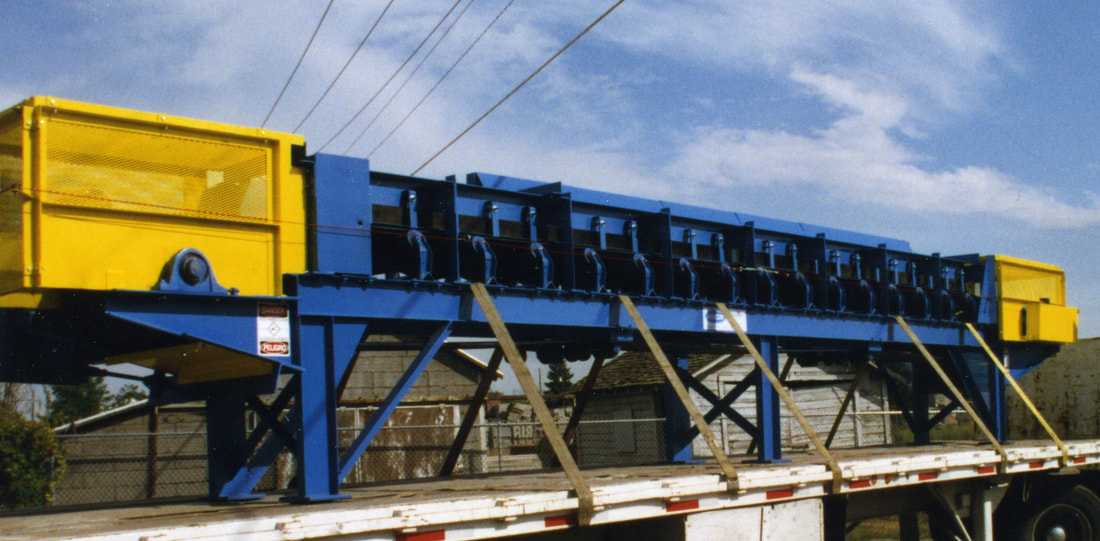
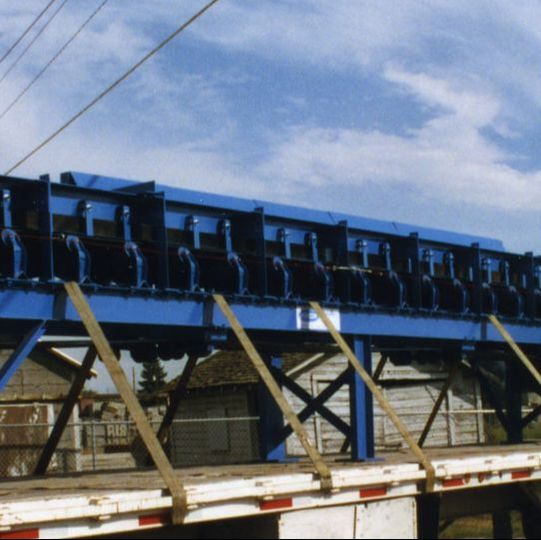
What carries over is the shop, not a track record in rock. Remcon comes at this work from the recycling industry, equipment that handles materials that are rough on machines, such as whole and broken glass and tin and aluminum cans, and we have built machinery for mining, construction, and manufacturing alongside our recycling and solid waste lines since 1977. Glass and cans are not crushed basalt, and nobody here will tell you otherwise. What transfers is the fabrication, the component selection, and the crews that install it.
One number from that sand job, because nobody else publishes theirs. The idler line on the drawing reads PPI, CEMA class C, 18-inch belt, 5-inch rolls, a 35-degree carrying trough, and a 20-degree flat return. That is what the material and the layout called for on that job. It is not a house standard, and anyone who quotes you a class before asking what you are moving is guessing.
The Drive
Remcon's conveyor drive standard is the Dodge Torque Arm II shaft-mounted reducer, v-belt driven. These reducers have been used almost exclusively in the sand, rock, gravel, and mining industries for many years, and are well proven. Remcon has used them since 1990.
Read that for what it says. It is a claim about the reducer, not about us. What it means for a quarry buyer is that the drive on a Remcon conveyor is the same drive family the pits have run for decades, and parts for it sit on a distributor's shelf rather than in one shop in Washington. Sizing and bearings: conveyor drive and bearing specs that actually matter.
Conveyor or Truck Haul
Any fixed conveyor run in a pit competes with a haul road and a truck. Do that arithmetic before anyone quotes steel.
The tradeoff is capital cost against operating cost. A study of an iron ore operation in Brazil put the capital cost of a haul truck fleet at a little over half the cost of building the conveyor, while the operating cost of moving a ton by conveyor came out at about a quarter of the truck cost, with 29 percent lower carbon emissions. That is the general pattern: conveyors cost more to put in, cost less per ton to run, and need less maintenance per ton over the same distance.
So a conveyor wins on two fixed points, a lot of material, and years of it. What a conveyor cannot do is move. If the face keeps advancing, or the volume between two points is occasional, the truck is still the right tool and we will say so. None of that depends on a claim about Remcon. It is arithmetic about your site.
A Quarry Conveyor Manufacturer, Not a Catalog
Much of what sells quarry conveyors online is a catalog with a logo on it: an importer or a belting house putting its own name on somebody else's machine. Remcon is a quarry conveyor manufacturer in the literal sense. The design, the steel, and the installation crew come out of one building in Airway Heights, Washington, and no conveyor leaves here as a shelf model. Every machine is designed, fabricated, installed, and later repaired by the same shop, which is why the specifications below are ranges and selections rather than model numbers. A custom quarry conveyor that has to fit between an existing screen tower and a stockpile is a drawing problem before it is a manufacturing problem. Frames are heavy welded steel, sized to the load and the site, and long runs ship in bolted sections for assembly on site.
- Dimensions that match the site. Length, lift, discharge height, and frame set by where the machine has to go.
- One shop for the surrounding steel. Hoppers, chutes, bins and bunkers, and the catwalks and ladders that let somebody reach the machine.
- Equipment we do not fabricate, bought in and engineered into the line. A plant is never all one shop's steel. Where the layout calls for a machine that is somebody else's specialty, it gets designed into the elevations and the interfaces rather than left at the property line for the buyer to reconcile. Which pieces are fabricated here and which are bought gets named job by job: see turn-key conveyor systems.
- Nationwide shipping and installation. Conveyors ship from Airway Heights, Washington, and Remcon's own crews erect them. See installation services.
- Parts after the sale. Replacement belts and parts for the life of the machine, for our equipment and other brands.
That is the first question worth asking a vendor. The second is who owns the drawing. Every plant of any size has equipment from more than one maker in it, and lines fail at the interfaces between them, not in the middle of a belt. A shop that draws, welds, and erects its own conveyors is the one that can own those interfaces, whoever built the machine on the other side of them.
Covers for Outdoor Service
Most quarry runs are outdoors, which adds two problems the plant floor does not have. Rain and snow soak the product and can slip the belt. Wind lifts fines off the belt and scatters them across the site. Covers and hoods over the carrying run address both, and shield the belt and idlers from UV and grit besides. Fugitive dust is regulated, so on some sites a cover is a permit question rather than a housekeeping one. Remcon builds covers and hoods into conveyors that run outdoors or carry material that cannot be allowed to blow around.
Guarding, Walkways, and What MSHA Part 56 Asks of Them
A surface quarry or a sand and gravel pit is a mine. It is inspected by MSHA under 30 CFR Part 56, Safety and Health Standards—Surface Metal and Nonmetal Mines, rather than by OSHA, and Part 57 is the underground counterpart. That is worth knowing before a conveyor gets drawn, because several of its standards are about steel that comes out of a fabrication shop: guards, railings, walkways and stairs.
Guards, and the seven-foot rule
56.14107 names the parts. Moving machine parts have to be guarded to protect people from contacting gears, sprockets, chains, drive, head, tail and takeup pulleys, flywheels, couplings, shafts, fan blades and similar moving parts that can cause injury. Guards are not required where those parts are at least seven feet away from walking or working surfaces.
Read the exemption carefully, because it cuts both ways. It is measured from walking and working surfaces, so putting a maintenance platform under a drive can turn an unguarded head end into one that now needs guarding. That is a layout decision, taken when the catwalk is drawn rather than discovered when it goes in.
56.14112 is about the guard itself: it has to withstand the vibration, shock and wear of normal operation, must not create a hazard by its use, and has to be securely in place while the machine is running, except for testing or adjustments that cannot be made with it off. The practical translation is short. A guard that has to come off to reach a grease fitting comes off and stays off. Hinged panels, captive fasteners, and grease lines run out to a fitting on the outside of the guard are fabrication decisions, cheap at the drawing and expensive afterwards.
The travelway beside the belt
56.14109 covers unguarded conveyors next to travelways, and it is a genuine either/or. Such a conveyor needs either emergency stop devices located so that a person falling on or against it can readily deactivate the conveyor drive motor, or railings positioned to prevent people falling on or against it, able to withstand the vibration, shock and wear of normal operation, and constructed and maintained so they do not create a hazard themselves.
Which one you choose changes the steel. A pull cord down the length of a run needs mounting brackets, corner pulleys, and switches at intervals along every side people walk. A railing needs posts, and posts need something to land on. The Pit & Quarry University handbook gives the same advice from the operator's side: design safety into the conveyor from the start, fit continuous emergency shutoff pull cords, and enclose return rolls to take out the pinch points. Either answer is cheaper as a line on a drawing than as a retrofit around a running belt.
Access, crossovers and toeboards
Two short standards carry most of the access work. 56.11001: safe means of access shall be provided and maintained to all working places. 56.11002: crossovers, elevated walkways, elevated ramps and stairways shall be of substantial construction, provided with handrails, and maintained in good condition, and where necessary toeboards shall be provided.
On a plant that reads as a walkway beside an elevated run wide enough to actually work from, a crossover over a belt rather than a step across it, a stair to the head pulley rather than a climb up the frame, and a toeboard so a dropped wrench does not reach whoever is underneath. Remcon builds platforms, maintenance catwalks, stairways and ladder access custom-fit to existing structures and machinery, and installs them with its own crews.
What Remcon claims here, and what it does not
Remcon is not the party that certifies your site, and there is no compliance package to buy. What Remcon does is fabricate the steel to the standard the site is inspected against, so the useful thing to say at quote time is which standard that is. Say OSHA, as a recycling plant would, and the access steel gets drawn to OSHA. Say Part 56 and it gets drawn to Part 56, and the difference lands on the guard panels, the railing, the crossover, and where the pull cord and its switches go. Asked at the drawing, it costs a conversation. Asked after the steel is cut, it costs twice.
Quarry & Aggregate Conveyor Specifications
The real numbers and the real selections. Where something is quoted per job it says so.
| Item | What Remcon builds |
|---|---|
| Belt width | 12 to 72 inches across the Remcon conveyor line. Be honest about the bottom of that: 12 inches is a fines-and-parts width, not an aggregate width. CEMA's troughing idler classes cover belts from 18 inches up to 120. For rock, you are shopping the middle and upper part of our range. |
| Trough angle | 20, 35, and 45 degrees, the common industry angles. Selected with the belt, not before it. |
| Carrying idlers | Three-roll troughing idler sets. Diameter, class, and spacing sized to the application and quoted per job. |
| Return rolls | Flat return rolls carrying the empty belt back beneath the frame. |
| Load zone | Rubber cushion-disc impact idler sets, as lump size and drop height require. |
| Belt | Rubber or PVC, matched to the material and the trough angle. Cover grade and thickness specified for the duty. |
| Drive | Dodge Torque Arm II shaft-mounted reducer, v-belt driven. In use at Remcon since 1990. |
| Frame | Heavy-duty welded steel, fabricated for the site and the load. Long runs ship in bolted sections. |
| Length, lift, discharge height | Sized to the layout and quoted per job. |
| Capacity | Not published. Tell us the material, the lump size, and the tonnage, and belt width, speed, and trough angle get sized around them. |
| Options | Covers and hoods for outdoor service, hoppers, chutes, skirting, belt sidewalls, cleats, catwalks. |
| Installation | Shipped and installed nationwide from Airway Heights, WA, by Remcon's own crews. |
What We Need to Quote It
A useful quote starts from six things, none a model number.
- The material, and its largest lump.
- The tonnage you need through it.
- Where it picks up, where it discharges, and the lift between.
- What loads it, and from what height: crusher, screen deck, hopper, front loader.
- Indoors or outdoors.
- What is already there, if the machine has to fit an existing plant.
Send that and you get a design rather than a cut sheet. Remcon also repairs, rebuilds, and relocates equipment that is already installed, so if the question is whether an existing run is worth saving, that is a conversation too. See the rest of the line on the conveyors page, or get a quote.
Quarry & Aggregate Conveyor FAQ
Does Remcon build conveyors for quarries and aggregate plants?
Yes, built to order. Remcon has fabricated a heavy-duty troughing idler conveyor for a silver mine, sand conveyors, a drag chain belt for a contractor who services mines, and a magnetite separation job. Remcon has run its recycling and solid waste equipment lines since 1977 and has built machinery for mining, construction, and manufacturing alongside them. What carries over is the engineering: Remcon comes at this work from the recycling industry, building equipment for materials that are rough on machines, such as whole and broken glass and tin and aluminum cans. Quarry and aggregate conveyors are designed, fabricated, and installed to order out of Airway Heights, Washington.
What belt widths do you build for aggregate?
The Remcon conveyor line runs 12 to 72 inches, and for crushed rock, sand, and gravel you are shopping the middle and upper part of that range. CEMA's troughing idler classes start at an 18-inch belt, so 12 inches is a fines-and-parts width rather than an aggregate width. Width also interacts with speed: a wider belt moves the same tonnage slower, which is easier on covers, bearings, and transfers.
How do you keep chutes and hoppers from wearing out in rock service?
With abrasion-resistant plate in the high-wear zones, bolted in as a replaceable liner rather than welded in as part of the structure. Chutes, impact walls, hopper walls, and discharge points take sliding abrasion and impact continuously, and the point of a bolt-in liner is that the wear surface is a consumable while the vessel underneath is not. Which grade goes where is covered in our stainless vs. abrasion resistance guide.
When does a conveyor beat hauling with trucks?
When both ends are fixed and the material keeps moving between them for years. Conveyors generally cost more to install and much less to run. One study of an iron ore operation put conveyor operating cost per ton at roughly a quarter of truck haulage, with 29 percent lower emissions, against a truck fleet whose capital cost was a little over half that of the conveyor. What a conveyor cannot do is move, so an advancing face or a destination that changes seasonally still favors trucks.
Do you build covered conveyors for outdoor quarry runs?
Yes. Covers and hoods over the carrying run keep rain and snow off the product, stop wind from lifting fines off the belt, and shield the belt and idlers from UV and grit. Some jurisdictions require conveyors to be covered to limit dust dispersion. Say at quote time that the run is outdoors, so covers are designed in rather than bolted on afterward.
Can Remcon ship and install a conveyor outside Washington?
Yes. Conveyors are designed and fabricated in Airway Heights, Washington, outside Spokane, then shipped and installed nationwide by Remcon's own crews. Long runs ship in bolted sections so they can be trucked and assembled on site. We also supply replacement belts and parts for the life of the machine, for our own equipment and other brands.
Where would a shuttle conveyor fit in an aggregate plant?
Wherever one stream has to reach several destinations under a roof: a row of product or surge bins, aggregate bins under a batch plant, enclosed storage. Because the belt reverses and discharges off either end, the machine needs to be only a little over half the length of the row it serves, and travels to cover the rest. Outdoor stockpiling is a different question. Out in the yard a fixed inclined conveyor is usually the cheaper answer.
Can one conveyor fill several product bins without diverter gates?
That is what a shuttle conveyor does. Instead of splitting the stream upstream with gates or chutes, the whole machine moves: it rides a fixed track above the row, stops where the controls put it, and reverses the belt to drop into whichever position it is parked over. One belt drive and one travel drive replace a dedicated conveyor over every bin, and nothing sits in the material path for rock to wedge in. Remcon builds the bins and bunker walls as well.
Can Remcon build the conveyor that feeds a radial stacking conveyor?
Yes. That is a fixed conveyor like any other, sized to the material, the lump, and the lift, and built to the receiving machine's dimensions at the discharge end. What we need from the stacking conveyor is its feed height and how far that height moves through its working range, its infeed belt width and receiving opening, its belt speed and direction at the handoff, and the radius it sweeps so the fixed run, its footings, and the walkway stand clear of the arc and of the pile. Those numbers come from the stacking conveyor's manufacturer. With them, the material, and the site layout, the fixed run gets drawn to fit rather than corrected on the pad.
Does Remcon build radial stacking conveyors?
No, and it is worth being exact about where the line runs. A portable radial stacker, telescopic or not, is a purpose-built machine from its own manufacturer. Remcon fabricates the fixed conveyors around it: the run that feeds it, the surge hopper or bin that keeps it fed, the reclaim conveyor under the pile, the chutes, and the platforms and ladders. Remcon builds those to the stacking conveyor's published dimensions, so the elevations and the transfer line up on site rather than getting discovered there.
Will a stacking conveyor fix stockpile segregation?
It changes the shape of the problem rather than deleting it. Graniterock's technical report on aggregate base stockpiles is direct about the upside: a stockpile built up in continuous layers reduces the effects of segregation and removes the need to reblend the base before shipment, and it names a radial or telescopic conveyor as a way to build one. What that does not settle is what leaves the site. A pile is only as good as the way it comes back out, and the same report warns against building a pile so high the loader has to drive on the material, because that degrades and can contaminate it. Decide the reclaim method before anyone sizes the machinery that builds the pile: the reclaim conveyor and the stacking end have to be laid out against the same pile, and that is fixed conveyor work Remcon does.
Can Remcon design the conveyor run and the stockpile layout together?
That is the useful version of the job. Feed height, the arc the stacking machine sweeps, where the pile toe lands, where the fixed run and its footings can stand, where the reclaim conveyor and its tunnel or trench go, and where the surge sits between the plant and the pile are one drawing, not five. Remcon designs, fabricates, and installs the fixed conveyors and the surrounding steel with its own crews out of Airway Heights, Washington, and builds to the manufacturer's dimensions for the machines it does not fabricate. Turn-key conveyor systems covers how that scope gets written.
Do you build overland conveyors?
No. Overland conveyors cross ground instead of moving material around a plant, running from a few hundred feet to several miles on trestles, commonly on a truss frame so the spans between supports can be long. That is a different product category with its own suppliers. What Remcon builds is the fixed conveyor and the steel around it, whatever the plant calls it at that point in the line: the belt under a crusher, the closed-circuit return, the belt off a screen deck, the transfers between stages, the reclaim and load-out runs, and the surge bins, chutes, skirtboard and access steel that go with them. Where an overland conveyor is part of the project, the fixed steel at either end of it is work Remcon does, built to the overland supplier's published dimensions the same way we build to a stacking conveyor's.
How many tons per hour will your conveyors run?
Remcon publishes no TPH rating, because on a machine built to order that number belongs to your material rather than to our catalog. Capacity off a troughed belt is the cross-sectional area of material on it, times belt speed, times bulk density. The area moves with belt width, trough angle, the surcharge angle your rock holds on a moving belt, and the edge distance that has to stay empty, and an inclined run gives back a slope correction factor on top of that. Belt speed on hard, sharp rock is held to a conservative band so the covers survive. Send us the TPH you need, the material and its real top size, roughly what fraction of the feed sits at that top size, the elevations and the center distance, and belt width, speed, trough angle and idler selection get sized around them and quoted for the job.
Are your conveyors built to MSHA Part 56?
A surface quarry or sand and gravel pit is a mine, inspected under 30 CFR Part 56 rather than by OSHA. Tell us at quote time that Part 56 is the standard your site is inspected against and the guarding and access steel gets drawn to it: guards on the drive, head, tail and takeup pulleys and the shafts and couplings around them, or the seven-foot clearance that exempts them; an emergency stop device or a railing where a travelway runs beside an unguarded belt; handrails and, where needed, toeboards on crossovers, elevated walkways and stairways. Remcon fabricates and installs that steel. What Remcon does not do is certify the site or sell a compliance package. The standard is yours, the steel is ours, and one sentence on the quote request saying which standard applies is all it takes to get it drawn right.
What size rock can go on a 36 inch belt?
Lump size sets belt width before tonnage does, and gradation matters as much as top size, which is why the sizing tables carry a column for feed that arrives all one size and a second, more generous column for feed carrying plenty of fines. MEKA's handbook table puts the nearest width to a 36 inch belt, 900 mm, at 175 mm for the uniform case and 325 mm for the graded one, which is about a fifth of belt width against about a third. Same belt, nearly double the allowable rock, decided by gradation rather than steel. The other half of the answer is that the real lump is bigger than the setting: published design guidance says to work to two or three times whatever figure the setting gives you, because crusher settings get opened up and screens get run harder to chase production. Tell us the top size you actually see, not the closed side setting.