
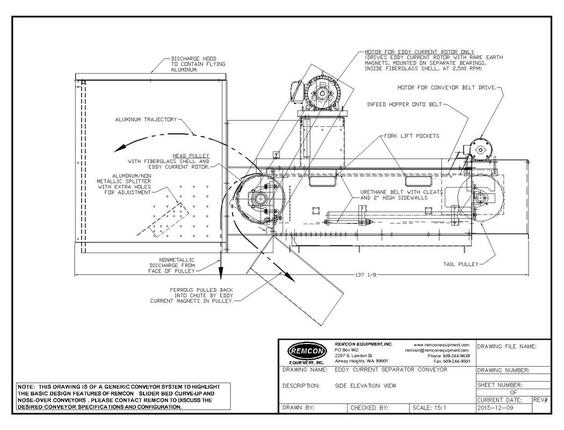
The Remcon eddy current separation conveyor utilizes rare earth magnets, specially arranged inside the conveyor head pulley, to remove both aluminum and ferrous materials from commingled recyclables. Aluminum is repelled into a chute ahead of the pulley, ferrous is attracted back to a chute behind the pulley, and other materials are dropped straight down into a third chute.
What Does an Eddy Current Separator Do?
An eddy current separator for aluminum recycling uses a fast-spinning rotor of rare earth magnets inside the head pulley of a conveyor. The alternating magnetic field induces eddy currents in any conductive non-ferrous metal riding the belt, and those currents generate an opposing magnetic field of their own — so aluminum is thrown forward off the end of the belt, while glass, plastic, and paper fall away on a normal ballistic path. The same rotor attracts ferrous metal back under the pulley. One machine, three clean streams: aluminum forward, ferrous back, everything else straight down.
Concentric & Eccentric Rotors
Remcon supplies two types of eddy current separators (ECS): concentric rotor and eccentric rotor separators. The rotor is essentially the conveyor pulley at the discharge end of the ECS that contains the rotating ECS magnets. Concentric rotor separators have rotors with magnets that rotate around an inner shaft that is positioned concentrically (evenly spaced) around the center of the outer pulley shell.
The concentric rotor separator is simpler in design and less costly than eccentric rotors. It is an effective option for medium and smaller volume operations that separate primarily aluminum cans.
Eccentric rotor separators mount the magnet assembly off-center inside the pulley shell, which concentrates the magnetic field in the zone where material leaves the belt. Because the field is focused at the throw point rather than spread around the full circumference, ferrous that reaches the rotor sheds quickly instead of being dragged around the shell — the usual specification for fine aluminum and for higher-volume lines.
We buy rotors for the concentric versions and build the remainder of the machine, often with custom design modifications to better fit certain applications: custom support stands, infeed conveyors, outfeed conveyors and blowers, transitions and chutes, and more.
Infeed conveyors for separator lines →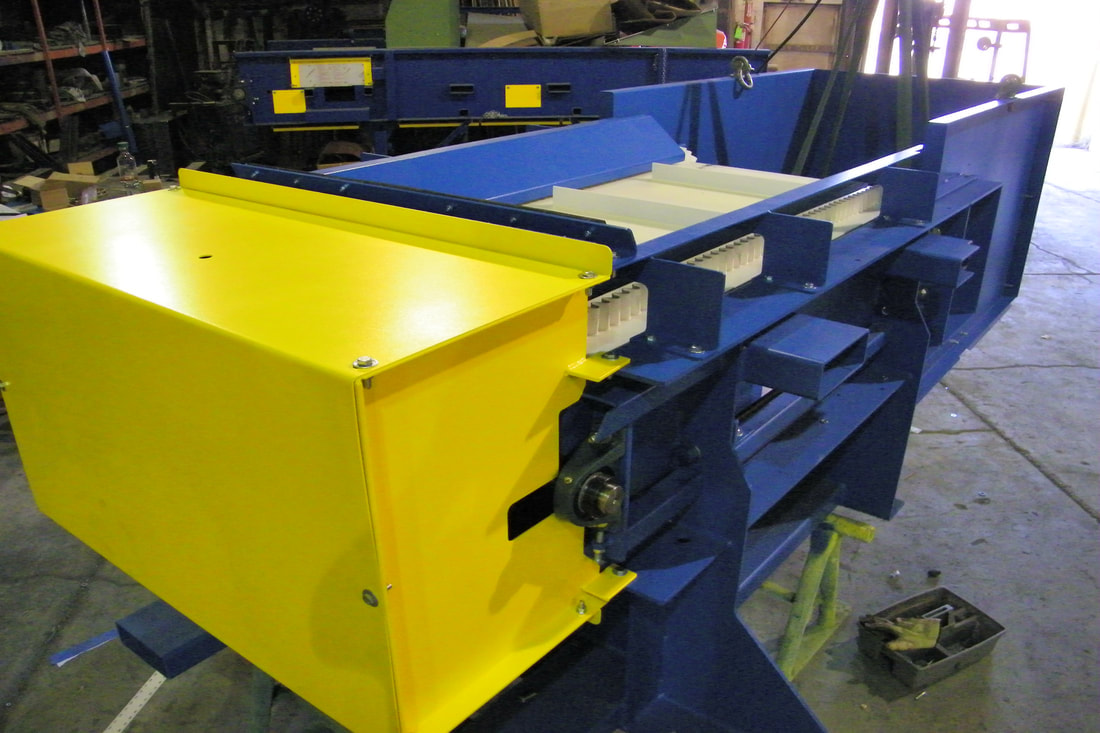
Aluminum Recovery in Single-Stream MRFs
In a single-stream MRF, fiber and containers arrive commingled, and by the time the container line reaches the back of the plant it is carrying steel cans, aluminum cans, plastics, and broken glass together. Aluminum is one of the highest-value commodities on that line, and it is usually recovered last — after the screens have taken out the fiber and an overhead magnetic separator has pulled the bulk of the ferrous. Stripping ferrous upstream matters: the less tramp iron that reaches the rotor, the cleaner the aluminum product and the easier the rotor's job.
Because the Remcon separator is built on a conveyor, it drops into a plant like one. We build the support stands to match your line heights, the infeed and outfeed conveyors around the machine, and the transitions and chutes that carry each of the three product streams where it needs to go — one builder responsible for the whole run, not a bare machine on a skid.
UBC (Used Beverage Can) Recovery
UBC recovery — pulling used beverage cans out of a commingled stream — is the classic eddy current application, and the one the concentric rotor suits best. Whole and flattened aluminum cans carry plenty of conductive surface, so they take a strong throw from the rotor without needing the concentrated field of an eccentric machine — which is why the simpler concentric rotor is usually the right call for a can-focused operation.
On the Remcon machine, the 2" belt cleats on 18" spacing present the cans to the rotor in an even layer rather than a surge, and the hood splitter keeps the thrown aluminum cleanly divided from the non-metallic stream dropping below it. The machine shown in FIG. 01 above was built for exactly this duty.
Fine Aluminum Recovery
Fine aluminum — foil, shredded pieces, caps and rings, and the small aluminum left in glass cullet — is a harder separation than whole cans. A small piece of aluminum has less conductive mass, so the rotor induces weaker eddy currents in it and gets less throw. Recovering fines takes a stronger or more concentrated field, which is where rotor selection matters: Remcon rotors come in 12", 14", and 16" diameters, chosen by the size and density of the aluminum being removed, and the eccentric rotor puts the field right at the throw point where fine particles need it.
Belt construction matters just as much on fines. The Remcon separator runs a thin polyurethane belt precisely because a thicker belt holds the material farther from the rotor and dampens the eddy current effect. For glass recycling lines, that combination lets the separator pull residual aluminum out of cullet before the glass ships — and Remcon has also built complete tote bin conveying and dumping systems for broken glass, so the separator arrives already matched to the abuse cullet hands out.
Features & Specifications
Standard Specifications
| Specification | Remcon standard |
|---|---|
| Overall width | 66" with a 30" rotor |
| Overall length | 137" standard — other lengths available as needed |
| Belt speed | 200 FPM, fixed speed |
| Rotor diameter | 12", 14", or 16", selected by the size and density of the aluminum being removed |
| Rotor construction | High grade rare-earth permanent magnets, balanced, inside a replaceable fiberglass wear drum |
| Frame | Formed 3/8" plate steel with guarded access holes |
| Bed | 3/8" flat bar slats, slider style, with sealed belt edges |
| Belt | Polyurethane, hot-bonded endless, with 2" cleats on 18" spacing |
| Tail pulley | 14" diameter, crowned for belt tracking |
| Bearings | Dodge SXR pillow block with eccentric locking collar |
| Rotor drive motor | TECO-Westinghouse 10 HP, severe duty, TEFC |
| Conveyor belt drive motor | TECO-Westinghouse 3/4 HP, severe duty, TEFC |
Conveyor Construction
- Frame: Formed 3/8" plate steel dampens vibrations, with guarded access holes in the sides of the conveyor.
- Bed: 3/8" thick flat bar slat construction, slider style with sealed belt edges for reduced belt wear and safety. Slat bed construction decreases friction and drag from moisture on the belt and prevents abrasive debris from accumulating underneath the belt.
- Belt: Polyurethane provides the greatest strength with the least thickness, to avoid dampening the effect of the eddy current. The belt connection and sidewalls are permanently hot bonded at the factory, and the design of the conveyor structure allows endless belts to be installed and removed with minimal disassembly.
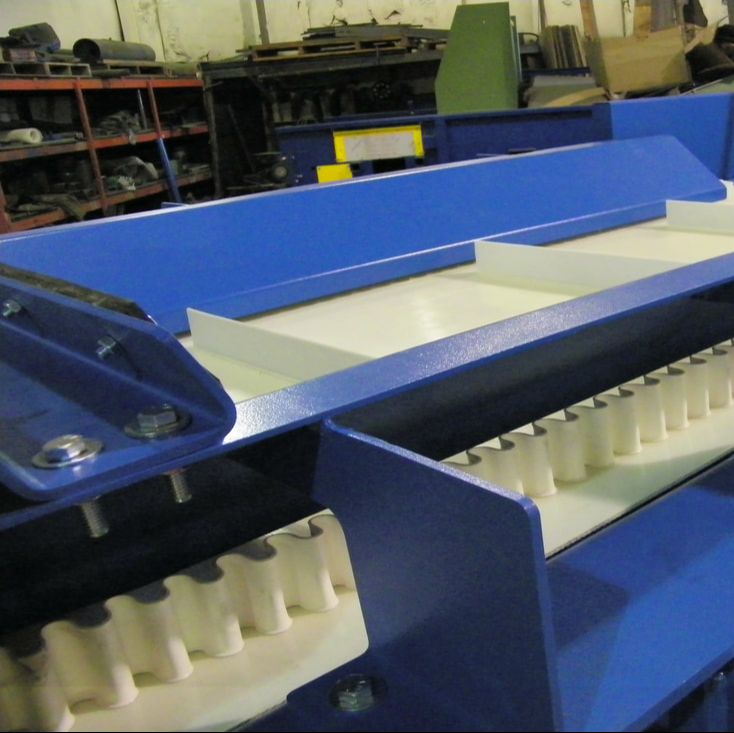
- Belt cleats: 2" tall on 18" spacing, high radio frequency welded to the top surface of the belt to move product efficiently, thereby reducing belt wear.
- Belt edge seals: A 2" tall PVC side wall is hot air welded to the surface of the belt, and steel skirting hangs over the belt sidewall to prevent glass and metal debris from working under the belt edge and causing premature belt wear.
- Belt speed: 200 feet per minute, fixed speed.
- Bearings: Dodge SXR pillow block with eccentric locking collar for better grip on the shaft.
- Tail pulley: 14" diameter, driven by a shaft-mount gear reducer and conveyor motor, crowned for belt tracking.
- Belt take-up: Remcon conveyors are equipped with extra-long belt take-up devices, which allow more than enough adjustment for the maximum guaranteed belt stretch.
- Hood: Splitter included to separate the metallic stream from the non-metallic stream.
- Legs: Custom built to support each eddy current separator as needed for each location.
Eddy Current Rotor (Conveyor Head Pulley)
- Rotor construction: Contains high grade rare-earth permanent magnets that are balanced for low vibration and long life.
- Rotor shell: A replaceable fiberglass wear drum covers and protects the inner rotor and supports the conveyor belt.
- Rotor diameter: Available in 12", 14", or 16", depending on what strength is needed based on the size and density of the aluminum objects being removed.
- Rotor width: Extra wide rotor design positions the bearings out of the magnetic field and keeps the product away from the edges of the belt to prolong belt and rotor life.
Drive Options
- Dodge Torque Arm II, parallel gear, shaft mounted gear reducer, sized to meet the American Gear Manufacturers Association class 2 rating.
- Nord Flexbloc™ worm-gear style shaft-mounted gearmotor, sized to meet the American Gear Manufacturers Association class 2 rating.
- Conveyor belt drive motor: TECO-Westinghouse 3/4 HP, severe duty, TEFC, 1.15 service factor, class F insulation for long motor life.
- Rotor drive motor: TECO-Westinghouse 10 HP, severe duty, TEFC, 1.15 service factor, class F insulation for long motor life.
Safety Features
- Emergency stop system: Cable-pull switch with cable and rigging as required by OSHA.
- Guards: All drive components guarded with hinged covers.
Eddy Current Separator FAQ
What does an eddy current separator do?
An eddy current separator removes aluminum and other non-ferrous metal from a mixed material stream. A rotor of rare earth magnets spins inside the conveyor head pulley and induces eddy currents in conductive metals, so aluminum is repelled into a chute ahead of the pulley, ferrous is attracted back to a chute behind the pulley, and everything else drops straight down into a third chute.
What is the difference between a concentric and an eccentric rotor?
On a concentric rotor, the magnets rotate around a shaft centered inside the outer pulley shell — a simpler, less costly machine that works well for medium and smaller volume operations separating primarily aluminum cans. On an eccentric rotor, the magnet assembly is mounted off-center so the field concentrates where material leaves the belt — the usual choice for fine aluminum and higher-volume lines. Remcon supplies both types.
Can an eddy current separator be retrofitted into an existing line?
Yes. Remcon builds each separator conveyor to fit the application — custom support stands, infeed and outfeed conveyors, transitions, and chutes — so the machine can drop into an existing sort line as well as a new system. Tell us your line heights and layout and we will design around them.
What material streams can an eddy current separator handle?
Common streams include used beverage cans (UBC), commingled single-stream containers, and glass cullet carrying residual aluminum. Rotor diameter — 12", 14", or 16" — is selected by the size and density of the aluminum being removed from the stream.
Does Remcon build the whole separator conveyor?
Yes. Remcon buys the rotor for concentric machines and builds the remainder of the separator conveyor — the plate steel frame, slider bed, polyurethane belt system, stands, hood, and chutes — plus the infeed and outfeed conveyors and blowers around it. One builder is responsible for the whole line.
Custom Designed for Your Operation
We specialize in custom designed and fabricated equipment and can work with you to design a separator that will work well for your needs. Every separator conveyor is designed and fabricated at our Airway Heights (Spokane), Washington shop, then shipped and installed nationwide. Contact us to discuss options or to get a quote.
Get a quote for an eddy current separator →