
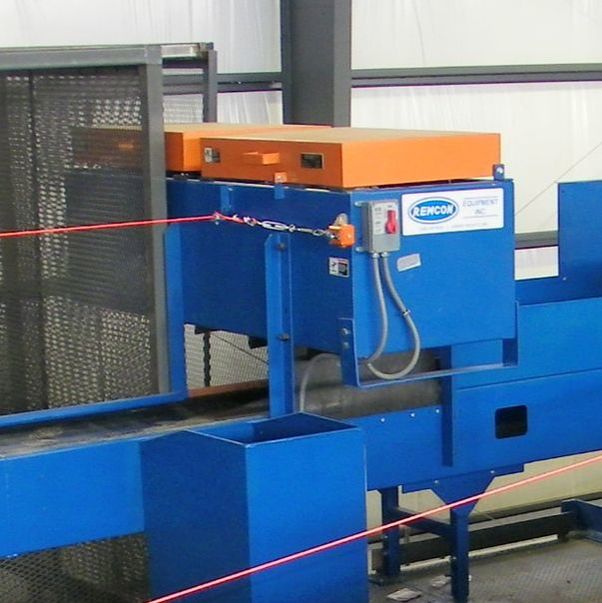
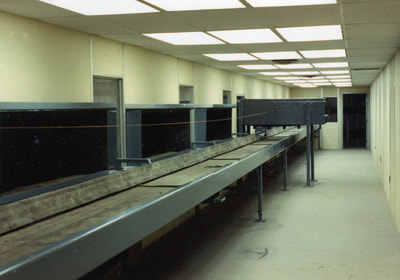
The Remcon Overhead Magnetic Separator utilizes specially arranged magnets, suspended over a conveyor belt, to remove ferrous materials from commingled recyclables. Once removed, the ferrous debris is conveyed away from the magnetic field to the desired location, to be dropped into a container, bin, or onto another conveyor. Magnetic separators can be built with either permanent magnets or electromagnets.
What Is an Overhead Magnetic Separator?
An overhead magnetic separator — also called a crossbelt magnet or overhead conveyor magnet — is a self-cleaning magnetic separator suspended over a conveyor belt. A plate magnet inside the unit pulls ferrous metal up out of the material stream and holds it against a short, cleated belt running around the magnet. That belt continuously carries the captured steel out of the magnetic field and releases it — into a bin, a container, or onto another conveyor — so the magnet never has to be shut down or picked clean by hand. Remcon integrates OMS units over both new conveyors we build and belts already in service.
Permanent Magnet Overhead Separators
A permanent magnet unit generates its field with permanent magnet material — no electrical power is needed to make the magnet itself work, and only the belt drive draws current. The field is always on: it cannot be switched off, does not drop when a breaker trips, and there is no coil, rectifier, or power supply to maintain. That makes the permanent style the simple, low-upkeep choice for most recycling and MRF duty, where the magnet hangs relatively close to the belt and runs all shift. Field strength is fixed when the magnet is built, so the unit is sized to the suspension height, belt width, and burden depth of the application.
Electromagnetic Overhead Separators
An electromagnetic unit generates its field with a wire coil wound around a steel core and energized by DC power. The advantage is reach and control: an electromagnet can be built to project a deep, strong field for higher suspension heights and deeper burdens, and the field can be switched off — useful for releasing captured tramp iron or de-energizing the magnet for maintenance. The trade-off is that an electromagnet needs a power supply, draws current whenever the field is on, and generates heat in the coil. Remcon builds overhead separators both ways and will recommend the magnet type after looking at your material, burden depth, and mounting height.
Inline vs. Crossbelt Mounting
Remcon OMS units can be ordered to mount above a conveyor in two different orientations, and the plant layout usually makes the decision — where the recovered steel needs to land, and how much room there is around the conveyor below.
- In a crossbelt orientation, the OMS belt runs perpendicular to the conveyor below, transferring ferrous material to one side of the conveyor. A crossbelt magnet can hang anywhere along the run, which makes it the usual choice over sort lines — the steel discharges to a bin or container alongside the belt.
- In a parallel (inline) configuration, the OMS unit is mounted above the discharge end of the conveyor below, with the belts running parallel. The ferrous material is lifted from the lower conveyor and thrown beyond the non-ferrous material trajectory. Inline mounting suits the end of a belt where there is no side room, and it works with the material as it spreads out leaving the head pulley.
Features & Specifications
Belt
The 3-ply belt is equipped with 3-inch-high cleats 18 inches apart and is coupled by stainless steel lacing. This combination results in a high-strength belt with a 330 lb. per inch of width tensile strength rating.
Dimensions
All units are constructed of 3/16-inch steel plate. Typical dimensions are 96 inches long by 42 inches wide by 30 inches high. Dimensions may vary per specific applications.
Drive System
OMS Series units are equipped with 3/4 HP, totally enclosed, fan-cooled motors. Coupled by a V-belt drive to reduce shock loads and jamming hazards, the Dodge gear reducer is 100% sealed, eliminating the possibility of oil contamination.
Plate Magnet
The plate magnet produces both primary and secondary magnetic fields with an effective reach of 12 inches.
Pulleys
12-inch diameter crowned pulleys keep belt tracking true, minimizing time-consuming adjustments. All bearings are self-aligning, pillow-block style, sealed units requiring grease only bi-annually.
Belt Take-Ups
Remcon conveyors are equipped with extra-long belt take-up devices which allow more than enough adjustment for the maximum amount of guaranteed belt stretch.
OMS Series Specifications
Typical figures for the Remcon OMS Series are below. Every unit is built to order, so dimensions and magnet sizing are matched to the conveyor below — contact us to spec yours.
| Specification | Remcon OMS standard |
|---|---|
| Construction | 3/16" steel plate |
| Typical dimensions | 96" long × 42" wide × 30" high — varies per application |
| Magnet type | Permanent or electromagnetic |
| Plate magnet | Primary and secondary fields, effective reach of 12" |
| Belt | 3-ply, 3"-high cleats on 18" centers, stainless steel lacing — 330 lb. per inch of width tensile strength |
| Drive | 3/4 HP totally enclosed fan-cooled motor, V-belt drive, 100% sealed Dodge gear reducer |
| Pulleys | 12" diameter, crowned for belt tracking |
| Bearings | Self-aligning pillow-block, sealed — grease bi-annually |
| Mounting | Crossbelt or inline (parallel), per layout |
| Housing | Fully enclosed, hinged |
Safety Features
Fully Enclosed Housing
The Remcon crossbelt magnetic separator is completely enclosed with a hinged housing design. Belt edges, pinch points, and all hazardous drive components have all been covered to maximize safety.
Emergency Stop System
Remcon provides an emergency stop system as required per system layout.
Overhead Magnetic Separator FAQ
Permanent or electromagnetic — which do I need?
For most recycling and MRF duty, a permanent magnet unit is the right choice — the field is always on, there is no coil or power supply to maintain, and only the belt drive needs electricity. An electromagnet earns its keep where the magnet must hang higher over a deeper burden, or where being able to switch the field off matters. Remcon builds overhead separators both ways and will recommend one after seeing the application.
How high should an overhead magnet hang above the conveyor?
As low as the material allows — magnetic pull falls off quickly with distance, so the unit is suspended just high enough to clear the deepest burden that passes beneath it. The plate magnet in a Remcon OMS unit produces primary and secondary magnetic fields with an effective reach of 12 inches, and suspension height is set per installation based on burden depth and the size of the ferrous being recovered.
Should the magnet mount crossbelt or inline?
Crossbelt (cross belt) is the more common mounting, but the plant layout usually makes the decision. A crossbelt magnet hangs perpendicular to the conveyor, can mount anywhere along the run, and discharges steel to a bin or container beside the belt. An inline (parallel) unit mounts over the discharge end and throws the ferrous beyond the trajectory of the non-ferrous stream — the fit where there is no room alongside the conveyor.
Does the magnet clean itself, or do I have to pull the steel off?
The belt is self-cleaning — that is the point of an overhead magnetic separator. The cleated belt running around the magnet continuously carries captured ferrous out of the magnetic field and drops it into a bin, container, or onto another conveyor, so nobody pulls steel off a magnet face by hand. On Remcon OMS units that belt is 3-ply with 3-inch cleats every 18 inches, laced with stainless steel.
Can an overhead magnetic separator hang over a conveyor I already run?
Yes — an overhead magnetic separator is a self-contained machine, with its own belt, drive, and enclosed housing, so it can be suspended over an existing conveyor as readily as a new one. The installation needs headroom above the belt and structure to hang the unit from, and the suspension height has to suit the burden. Remcon integrates OMS units over both new and existing belts.
Do I need an overhead magnet if I have a magnetic head pulley?
The two do different jobs, and many plants run both. An overhead magnet lifts ferrous up out of the burden anywhere along the belt and handles the bulk of the removal; a magnetic head pulley, built into the discharge end of the conveyor itself, catches steel riding at the belt surface as a final check. See our magnetic head pulley page for the pulley side.
Custom Designed for Your System
We specialize in custom designed and fabricated equipment and can work with you to design a solution that will work well for your needs. The magnet itself is purchased — permanent or electromagnetic, selected against the burden depth, the suspension height, and the tramp being pulled. What we build is everything around it: the cleated self-cleaning belt and its drive, the suspension frame, the support structure, and the chute or container the ferrous drops into. That machine is designed and fabricated at our Airway Heights (Spokane), Washington shop, then shipped and installed nationwide. See turn-key conveyor systems for how the bought and fabricated halves get written into one scope. Contact us to discuss options or to get a quote.
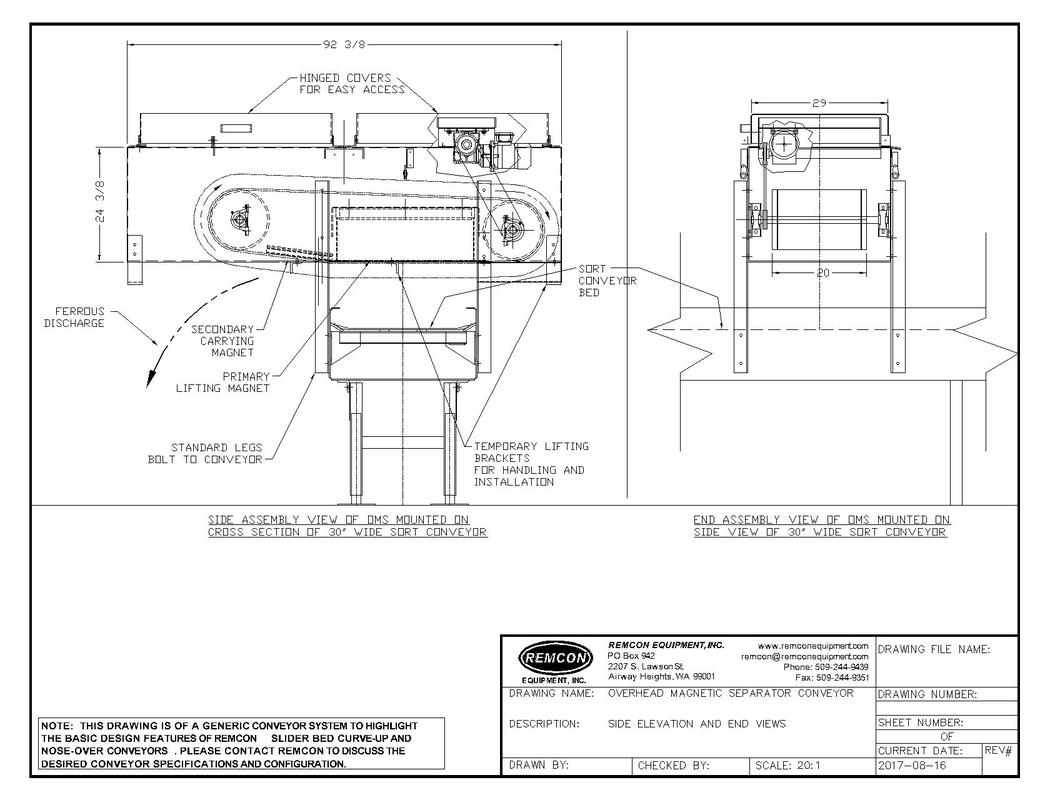
Get a quote for an overhead magnetic separator →Overhead Magnetic Sorter Drawing
A generic drawing of the overhead magnetic sorter conveyor, showing the basic design features. Contact Remcon to work out the specification for your line.
Overhead magnetic sorter conveyor features (PDF) →