
Blowers can sometimes be used to convey material instead of a belt conveyor. This can be useful in tight spaces, or if multiple turns and changes in elevation are needed to get the material where it needs to go. Remcon incorporates blowers for pneumatic conveying into recycling systems — carrying PET, HDPE, tin cans, and plastic film through overhead tube runs and into hoppers and storage bins.
What Is Pneumatic (Air) Conveying?
Pneumatic conveying — also called air conveying — moves material through a tube on a stream of moving air instead of on a belt or chain. A blower generates the airflow; material is fed into the air stream, carried through the tube in suspension, and released at the discharge end, where the air escapes and the material drops into a bin, hopper, or onto the next conveyor. Because the conveying path is just tubing, the run can turn corners, climb walls, and cross overhead — routing no belt frame could follow.
The trade-off is the material itself: air can only carry what it can lift. Pneumatic conveying suits light, sorted, free-moving material — plastic bottles, cans, film — while dense, heavy, or highly mixed streams stay on mechanical conveyors.
Air Conveying vs. a Mechanical Conveyor
A belt conveyor is the default in a recycling plant for good reason: it handles nearly any material — heavy, wet, sharp, or mixed — and it presents that material flat on a belt where sorters and separation equipment can work on it. But a belt needs a straight run between its pulleys, plus room for the frame, legs, and access alongside. In a crowded building or a retrofit, that room often isn't there.
Some rules of thumb:
- Choose a mechanical conveyor when the material is heavy, dense, or unsorted, when people or machines need to see and reach it in transit, or when the run is straight and there is floor space for a frame — see our transfer conveyors and slider bed conveyors.
- Choose air conveying when the material is light and consistent — sorted bottles, cans, or film — and the routing is the problem: tight spaces, multiple turns, changes in elevation, or an elevated bin or silo that a belt could only reach with a long incline.
- Many plants use both. Belts do the sorting and metering at floor level; a blower picks up a sorted commodity and carries it over everything else to storage.
Materials Remcon Conveys with Blowers
Remcon has incorporated blowers in systems for conveying PET, HDPE, tin cans, plastic film, and other materials into hoppers or storage bins. These are the commodities air handles well: once sorted, bottles, cans, and film are light for their size, so the air stream carries them without trouble. Film in particular — light, flat, and prone to catching wind — rides better inside a closed tube than on an open belt.
See storage bins, bunkers & hoppers →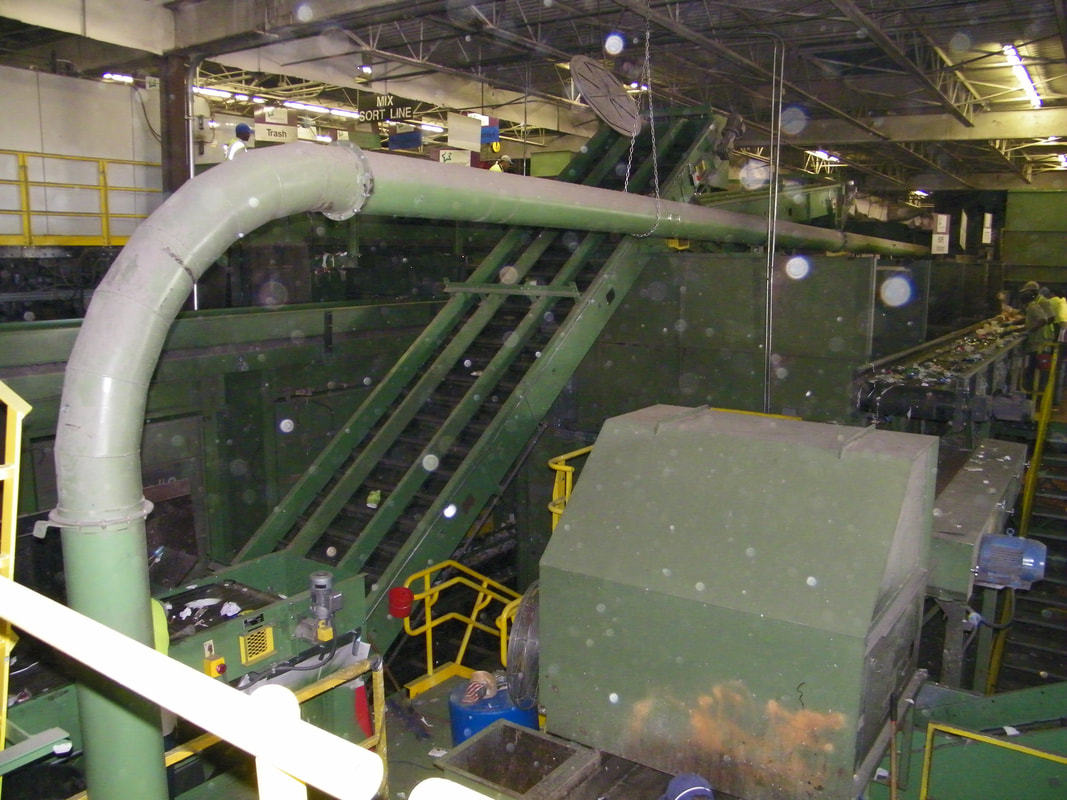
Tubing and Heavy-Duty Custom Hangers
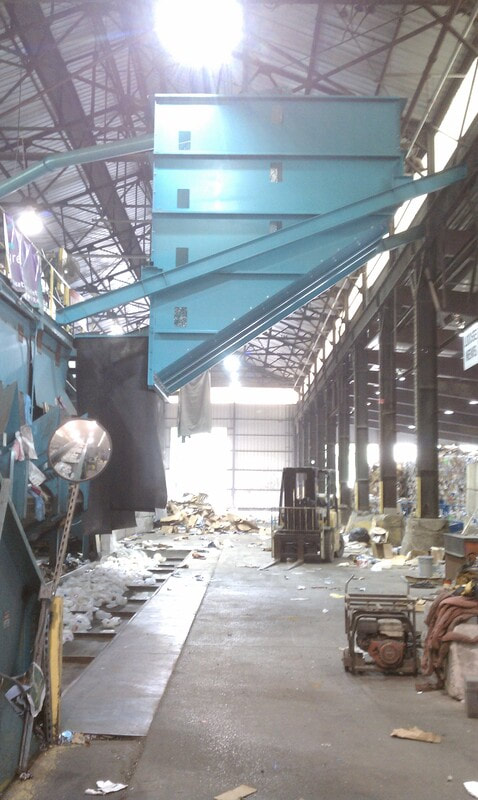
We have also provided and installed the tubing and heavy-duty custom hangers as needed, in difficult areas where "off-the-shelf" parts would not work. If your building's structure fights the routing, we fabricate the supports that make it work.
About our installation services →How Remcon Integrates Blowers with Conveyors and Bins
A blower is rarely a standalone machine — it's one leg of a system. Remcon has incorporated blowers into systems where they work alongside our belt conveyors and storage equipment:
- Filling elevated storage — a blower tube feeds an elevated storage bin or silo mounted over a baler feed conveyor (FIG. 02). Sorted material accumulates overhead, then discharges down onto the belt when the baler needs it.
- Carrying past obstructions — overhead tube runs move material over equipment, walkways, and work areas that a floor-level conveyor could not cross (FIG. 01).
- Separation lines — on eddy current aluminum separator lines, we build the infeed and outfeed conveyors, blowers, transitions, and chutes around the separator.
Because we design the whole turn-key system, the blower's discharge, the bin below it, and the conveyor after it are engineered together — not bolted together after the fact.
Blower Conveying System Specifications
Every blower system is engineered for the specific material and building, so the specifications below are qualitative — the numbers come out of the quote:
| Item | Remcon approach |
|---|---|
| Materials handled | PET, HDPE, tin cans, plastic film, and other light sorted materials |
| Blower | Selected and sized to the material and the run — quoted per job |
| Tubing | Provided and installed; routed through turns, elevation changes, and tight spaces as the building requires |
| Hangers & supports | Heavy-duty custom hangers, fabricated for difficult areas where off-the-shelf parts would not work |
| Discharge | Into hoppers, storage bins, or silos — or onto the next conveyor |
| Integration | Engineered alongside Remcon belt conveyors, bins, and separation equipment in turn-key systems |
| Installation | Above ground and overhead routing; installed by Remcon crews |
Blowers & Pneumatic Conveying FAQ
What is pneumatic conveying?
Pneumatic conveying — also called air conveying — moves material through a tube on a stream of air generated by a blower, instead of on a belt or chain. Material is fed into the air stream, carried through the tube in suspension, and released at the discharge end into a bin, hopper, or onto the next conveyor. Because the conveying path is just tubing, the run can make multiple turns and changes in elevation that a belt conveyor cannot.
When should I use a blower instead of a belt conveyor?
Use a blower when the material is light enough for air to carry and the routing is the problem: tight spaces, multiple turns, changes in elevation, or an elevated bin or silo that a belt could only reach with a long incline. Use a belt conveyor when the material is heavy, dense, or mixed, when sorters need to see and reach it, or when the run is straight and there is floor space for a frame. Many plants use both — belts for sorting and metering, a blower to carry sorted material to storage.
What materials can be conveyed with a blower?
Remcon has incorporated blowers in systems for conveying PET, HDPE, tin cans, plastic film, and other materials into hoppers or storage bins. Air conveying suits light, sorted, free-moving material; dense, heavy, or highly mixed streams stay on mechanical conveyors.
How much does a blower conveying system cost?
Every blower system is quoted for the specific job — cost depends on the material, the conveying distance, the number of turns and elevation changes, the tubing routing and supports the building requires, and the discharge point. Tell us the material, where it starts, and where it has to end up, and we'll quote the build — and if a belt conveyor is the simpler, less expensive answer, we'll tell you that instead. Call (509) 244-9439 for a quote.
Custom Designed for Your Plant
The tubing supports, hangers, and the conveyors and bins a blower works with are designed and fabricated at our Airway Heights (Spokane), Washington shop, then shipped and installed nationwide by our own crews.
We specialize in custom designed and fabricated equipment and can work with you to design a solution that will work well for your needs. Contact us to discuss options or to get a quote.
Get a quote for a blower system →