
Remcon can fabricate custom heavy-duty roller conveyors specifically designed for your application. Remcon builds non-driven roller conveyors (gravity fed, etc.) and driven or partially driven roller conveyors.
While we may not specialize in off-the-shelf, light-duty roller conveyors, people come to us when they need something more heavy-duty or more custom than other companies provide.
Remcon can design a roller conveyor for your application using off-the-shelf parts on a custom-built frame, or can swap out or custom-build some or all of the parts if standard off-the-shelf parts will not do the job.
Get a quote for a heavy-duty roller conveyor →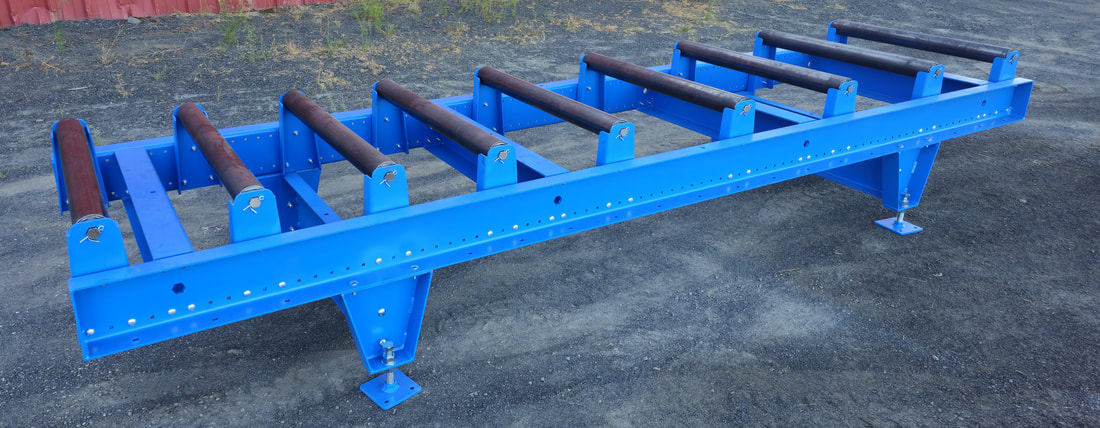
Gravity Roller Conveyors (Non-Driven)
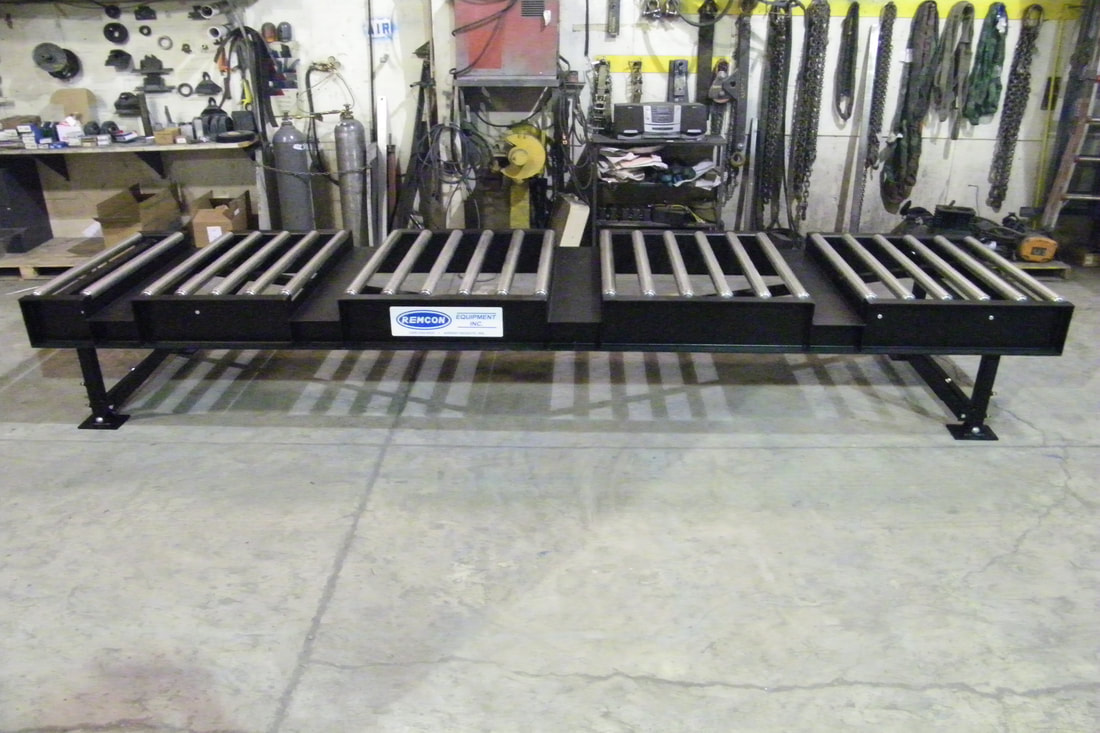
A gravity roller conveyor has no motor — the load rolls on free-turning rollers, moved by a slight downhill pitch, a push, or the forklift that set it down. There is nothing to power, but the rollers must keep turning freely under the full weight of the load — exactly where light catalog conveyors give up. Remcon builds the frame and rollers to the load, so heavy pallets and palletized product roll instead of stalling.
Driven & Partially Driven Roller Conveyors
A driven roller conveyor powers some or all of its rollers, moving the load along a level run without a push — for loads too heavy to move by hand, or where travel has to be controlled and repeatable. A partially driven conveyor powers only the sections that need it, with gravity doing the rest. Drive type and horsepower are sized to the load and the duty cycle, and quoted per job.
Advantages of Remcon Heavy-Duty Roller Conveyors
Remcon roller conveyors are specifically designed to handle large and heavy materials, making them ideal for industries that deal with substantial loads. A key feature of these conveyors is the clearance between the rollers, which allows for the safe passage of forklift forks, hoist straps, or crane chains beneath them.
This design facilitates easy loading and unloading, minimizing the need for additional lifting equipment and reducing the risk of damage to both materials and equipment. The spacious clearance enhances versatility, enabling the handling of bulky crates, pallets, and other large items efficiently.
Ideal for warehouses, manufacturing facilities, and distribution centers, roller conveyors streamline workflows and improve overall productivity in material handling operations. By customizing roller conveyors to accommodate large loads while ensuring adequate clearance for loading equipment, businesses can enhance their efficiency and effectiveness in transporting heavy materials.
What Makes a Roller Conveyor Heavy-Duty?
"Heavy-duty" gets printed on a lot of catalog pages. In practice it comes down to construction — what carries the weight, and what happens the day a forklift sets a load down harder than planned:
| Element | Light-duty catalog conveyor | Remcon heavy-duty build |
|---|---|---|
| Frame | Light-gauge formed rail, bolted together | Custom-built welded steel frame, designed for the load and the loading method |
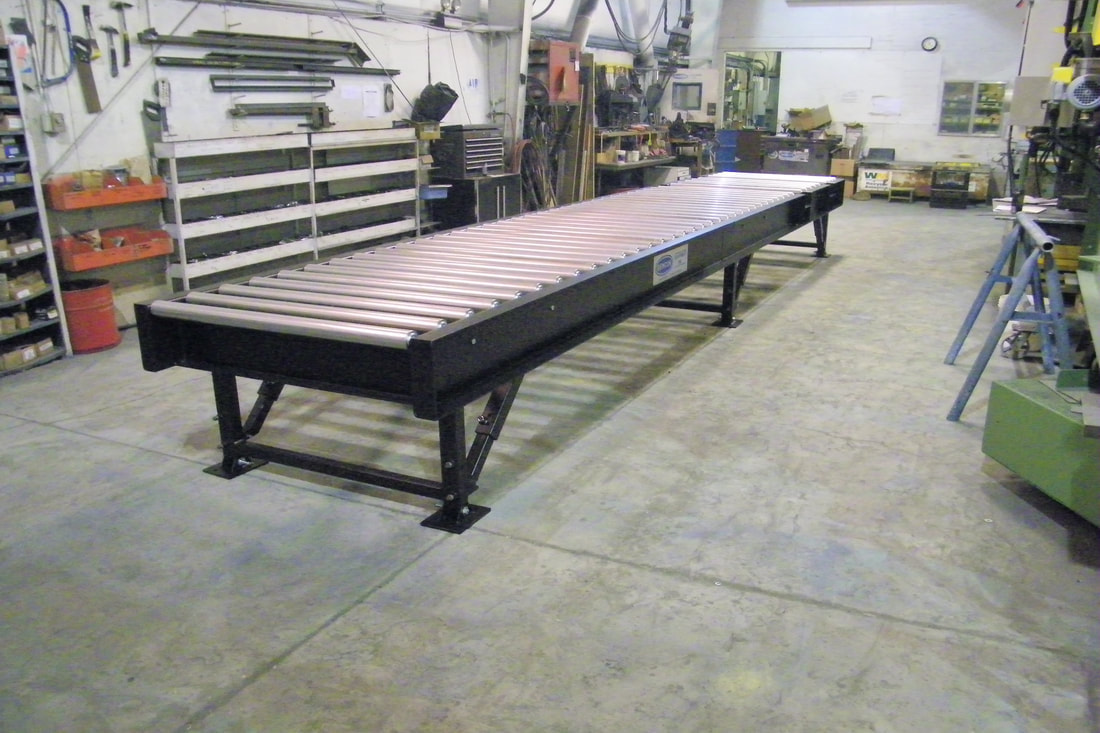
| Rollers | Thin-wall tube on light axles | Matched to the load — from drop-in, spring-loaded idler rollers up to custom-built rollers |
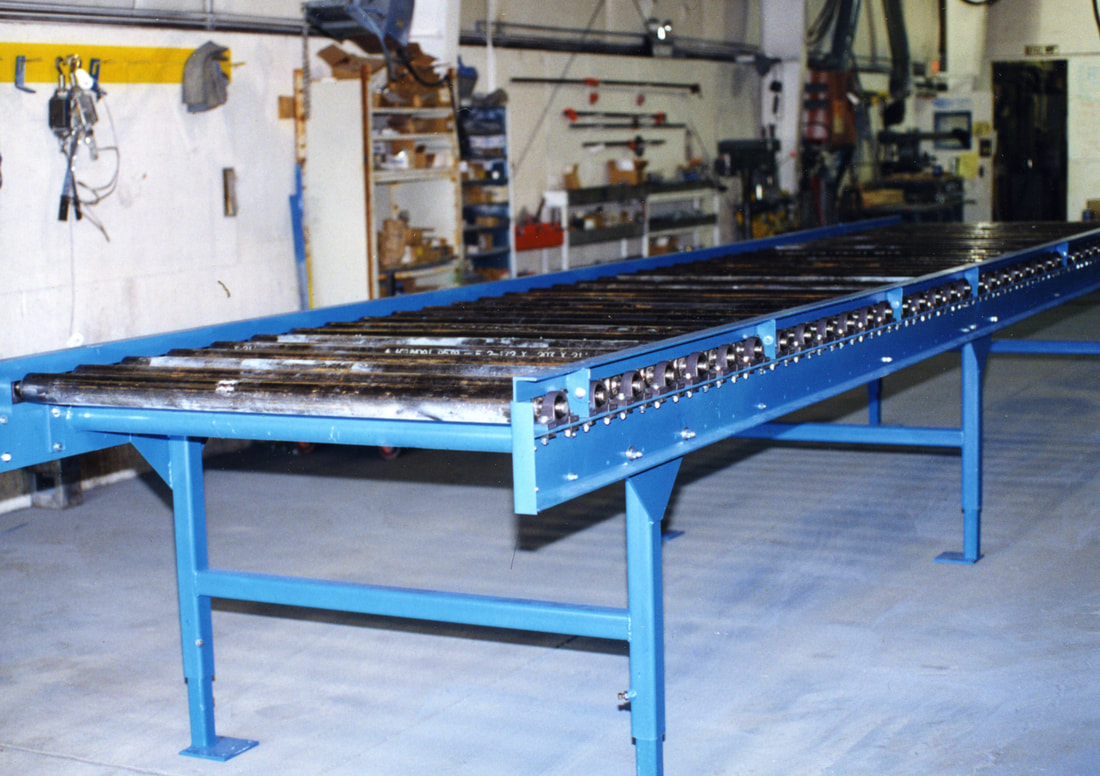
| Bearings | Pressed into the roller ends | Up to pillow block bearings bolted to the frame for the heaviest loads |
| Roller spacing | Fixed catalog pitch | Matched to the load footprint, so the load is always supported by multiple rollers |
| Loading | Hand-placed items | Forklift, hoist, or crane — roller clearance and fork pocket openings built in |
| Capacity | Catalog rating | Sized to the application — quoted per job |
The two conveyors pictured above bracket that range — drop-in, spring-loaded idler rollers on one, custom-built rollers on pillow block bearings carrying palletized concrete block on the other.
Materials & Industries
Roller conveyors carry unit loads — things that arrive on forks rather than in bulk. Remcon has built roller conveyors for loads as heavy as palletized concrete block, and this class of conveyor typically carries pallets, crates, and other large, heavy unit loads — including product moving down an OEM production line. Typical homes are warehouses, manufacturing facilities, and distribution centers — anywhere heavy items move between processes without tying up a forklift for the whole trip.
Sample Drawing
A recent example: a live floor roller chain conveyor for a storage bunker. The drawing shows how a Remcon roller-style build is laid out for a specific site.
Download the drawing (PDF) →Roller Conveyor FAQ
What is the difference between a gravity roller conveyor and a driven roller conveyor?
A gravity roller conveyor has no motor — the load rolls on free-turning rollers, moved by a slight decline or a push. A driven roller conveyor powers some or all of the rollers so loads move along a level run without a push, and a partially driven conveyor powers only the sections that need it. Remcon builds all three, sized to the load.
How much weight can a roller conveyor handle?
Capacity depends on the roller construction, the bearings, the roller spacing, and the frame, so Remcon sizes each conveyor to the actual load rather than to a catalog rating. Builds range from drop-in, spring-loaded idler rollers for general unit loads up to custom-built rollers on pillow block bearings for extra heavy loads such as palletized concrete block.
Can a roller conveyor be loaded with a forklift?
Yes. Remcon roller conveyors are designed with clearance between the rollers so forklift forks, hoist straps, or crane chains can pass beneath the load, and customer-specified fork pocket openings can be built into the frame. The frame itself is built to take forklift loading, not just the rolling weight.
How much does a custom heavy-duty roller conveyor cost?
Price depends on the load weight, the roller and bearing construction, gravity versus driven, the length, and how the conveyor will be loaded, so Remcon quotes each one individually. Tell us the load, the item size, and how you'll load it — forklift, hoist, or crane — and we will quote it. Call (509) 244-9439.
Every Remcon roller conveyor is designed and fabricated at our Airway Heights (Spokane), Washington shop, then shipped and installed nationwide.
We specialize in custom designed and fabricated equipment and can work with you to design a solution that will work well for your needs. Contact us to discuss options or to get a quote.
Contact us →