
Troughing idler conveyors carry the belt on rotating idler rollers instead of a solid bed. The rollers are mounted in a "U" shape, curving the edges of the belt up into a trough that keeps loose material from spilling over the sides — and because the belt rides on rollers rather than sliding, friction stays low, which makes this the standard conveyor for moving bulk material over long distances.
What Is a Troughing Idler Conveyor?
A troughing idler conveyor — also called a trough idler conveyor or troughed belt conveyor — is a belt conveyor whose rubber or PVC belt rides on sets of idler rollers angled to form the belt into a trough. The trough does two jobs: it contains loose material that would spill off a flat belt, and it centers the load so the belt tracks straight. Because each idler roller turns with the belt, the drive fights far less friction than on a slider bed conveyor, which is why this conveyor type is typically used to carry gravel, dirt, ore, and other bulk material — especially over long distances, where efficiency matters most. Remcon fabricates custom heavy-duty troughing idler conveyors designed for the specific application, rather than selling catalog units.
Anatomy of a Trough Idler Conveyor
Much of the vocabulary around this conveyor type comes from CEMA — the Conveyor Equipment Manufacturers Association — whose standards define idler classes, trough angles, and load ratings. When Remcon designs a trough idler conveyor, these are the components we select around your material, your tonnage, and your run:
Trough Angles — 20, 35, and 45 Degrees
The trough angle is the angle of the outer (wing) rollers relative to horizontal. The common industry angles are 20, 35, and 45 degrees. A deeper trough carries more material for a given belt width and contains it better, but it demands a more flexible belt that can form the trough without stressing at the idler junctions. A shallower trough suits stiffer, heavier belts. Trough angle, belt construction, and capacity get selected together — changing one changes the others.
Three-Roll Idler Sets
The standard carrying idler is a 3-roll set: a horizontal center roll flanked by two angled wing rolls. Sets are spaced along the carrying side of the conveyor, with the spacing set by belt width, material weight, and how much belt sag is acceptable between sets — heavier material and wider belts call for closer spacing and heavier idler classes. On a Remcon conveyor, idler diameter, class, and spacing are sized to the application and quoted per job.
Impact Idlers at the Load Zone
The load zone — where material drops onto the belt from a hopper, chute, or crusher discharge — takes the worst abuse on the whole conveyor. Impact idlers replace the steel rolls there with rubber cushion-disc rolls, typically spaced closer together, so the belt is supported and the shock of falling lumps is absorbed instead of hammering the belt cover and the idler bearings.
Return Idlers
Return idlers are flat rolls mounted under the frame that carry the empty belt back to the tail. They keep the return run from sagging or dragging, and they are a normal wear and inspection item over the life of the conveyor.
Belt Training
Belt training is keeping the belt running centered on the idlers and pulleys. It starts with square, aligned idler sets and properly set take-up tension, with tracking adjustment at the pulleys to dial the belt in; on long runs, self-aligning (training) idlers can be added to steer the belt back to center automatically. A troughed belt helps its own cause here — the trough centers the load, and a centered load keeps the belt tracking straight.
Custom Heavy-Duty Builds
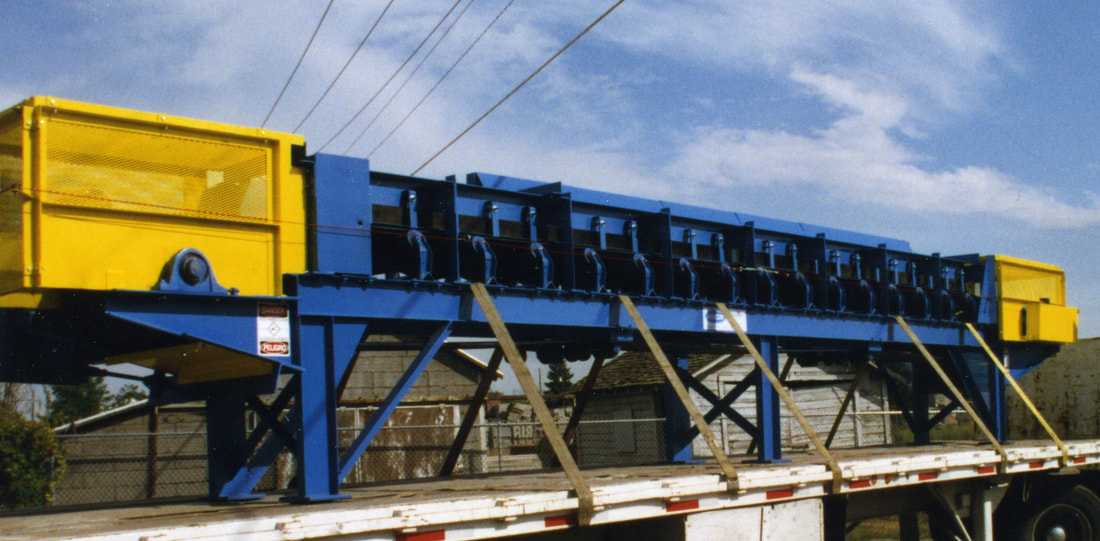
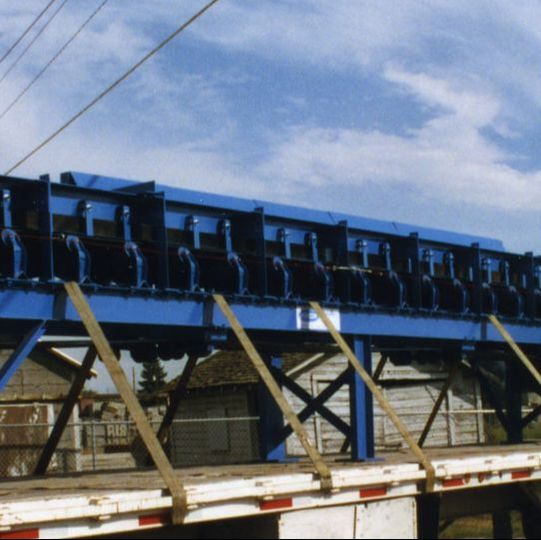
Remcon can fabricate custom heavy-duty troughing idler conveyors specifically designed for your application. The photos below show one of our builds: a heavy-duty troughing idler conveyor fabricated for a silver mine.
Built for Mining Service
Mining is about the hardest duty a belt conveyor sees. Ore is heavy, sharp, and abrasive; it lands on the belt in lumps rather than a gentle stream; and the conveyor is expected to run shift after shift, because a stopped conveyor stops the production behind it. That is the service the heavy-duty troughing idler conveyor shown above was built for. Remcon comes at this work from the recycling industry — equipment that handles materials that are rough on machines, such as whole and broken glass and tin and aluminum cans — and we have built machinery for mining, construction, and manufacturing alongside our recycling and solid waste lines since 1977.
Materials & Industries
Troughing idler conveyors are the default machine for loose bulk material — anywhere a flat belt would spill its load, a troughed belt contains it. Typical applications for this conveyor type include:
- Mining & quarry — ore and crushed rock, from crusher discharge to stockpile and load-out.
- Aggregate — sand and gravel, crushed stone, and screened products at pits and processing plants.
- Earthwork — dirt and soil, especially where a long conveying run beats truck hauling.
- Wood products — wood chips and similar loose organics that pile and spill on a flat belt.
Tell us the material and the tonnage — the belt, trough angle, and idlers get selected around them.
Troughing Idler or Slider Bed?
Remcon's specialty of building slider bed conveyors can often be applied to design a slider bed style conveyor that can be easier to maintain and less expensive than a troughing idler conveyor. But in some circumstances, a troughing idler conveyor is a better choice, or is simply the preferred choice of the end user. We can work with you to design the optimal conveyor to suit your needs.
The short version: rollers win on friction, slats win on simplicity. A troughing idler conveyor pulls heavy bulk material over long runs with less drive load, while a slider bed has no idler bearings to seize, inspect, or replace — an idler set every few feet is a recurring maintenance item that a slat bed simply doesn't have. Many systems use both types in series.
Compare slider bed conveyors →Troughing Idler Conveyor Specifications
Every Remcon conveyor is built to order, so a trough idler conveyor is specified around the material and the run rather than from a catalog page. The table below shows how the major items are typically specified:
| Item | How Remcon specifies it |
|---|---|
| Belt | Rubber or PVC, in a variety of materials, widths, and thicknesses — matched to the material carried and the trough angle |
| Trough angle | Selected per application — 20, 35, and 45 degrees are the common industry angles |
| Carrying idlers | Three-roll troughing idler sets; diameter, class, and spacing sized to the application — quoted per job |
| Impact idlers | Rubber cushion-disc sets at the load zone, as the loading conditions require |
| Return idlers | Flat return rolls carrying the empty belt beneath the frame |
| Frame | Heavy-duty welded steel, custom fabricated for the site and the load |
| Drive | Sized to the belt pull — Remcon has used shaft-mounted, v-belt-driven reducers since 1990, a drive family proven in sand, rock, gravel, and mining service |
| Length & lift | Sized to the application — quoted per job |
| Options | Cleats, belt sidewalls, hoppers, chutes, and hoods as the layout requires |
| Installation | Shipped and installed nationwide from Airway Heights, WA, with Remcon's own installation crews |
Troughing Idler Conveyor FAQ
What is a troughing idler conveyor?
A troughing idler conveyor is a belt conveyor whose belt rides on sets of idler rollers mounted in a "U" shape, so the edges of the belt curve up into a trough that contains loose material. Riding on rollers keeps belt friction low, which makes this conveyor type the standard for carrying bulk material — gravel, dirt, ore, aggregate — over long distances.
What trough angle do I need — 20, 35, or 45 degrees?
Common trough angles are 20, 35, and 45 degrees, and the right one depends on the material and the capacity required. A deeper trough carries more material for a given belt width and contains it better, but it demands a more flexible belt. Remcon selects the trough angle, idler sets, and belt together when we design the conveyor for your application.
Troughing idler or slider bed — which do I need?
Choose a troughing idler conveyor for long runs and heavy bulk material such as ore or aggregate, where lower belt friction matters most; choose a slider bed conveyor for light to medium loads, small or irregular material, and low-maintenance service. Remcon builds both — our slider bed specialty often lets us design a conveyor that is easier to maintain and less expensive, and when a troughing idler is the better choice, we will say so and build it heavy-duty.
What are impact idlers and do I need them?
Impact idlers are cushioned idler sets — typically rubber disc rolls — installed at the load zone to absorb the shock of material dropping onto the belt. If your conveyor is loaded with heavy lumps from a hopper, chute, or crusher discharge, impact idlers protect the belt cover and the idler bearings at the point that takes the worst abuse.
What materials do troughing idler conveyors handle?
Troughing idler conveyors handle loose bulk materials — ore, aggregate, sand and gravel, crushed rock, dirt, and wood chips. The troughed belt contains material that would spill off a flat belt, which is why this conveyor type dominates mining, quarry, and aggregate service. Remcon has built machinery for mining, construction, and manufacturing alongside its recycling lines, including a heavy-duty troughing idler conveyor for a silver mine.
How much does a custom troughing idler conveyor cost?
Price depends on belt width, length, trough angle, idler selection, drive size, and options such as impact idlers, hoppers, and hoods, so Remcon quotes each conveyor individually. Tell us the material, the tonnage, and the run and we will quote it — and if a simpler, less expensive conveyor can do the job, we will tell you that too. Call (509) 244-9439 for a quote.
Designed Around Your Application
We specialize in custom designed and fabricated equipment and can work with you to design a solution that will work well for your needs. Every troughing idler conveyor is designed and fabricated at our Airway Heights (Spokane), Washington shop, then shipped and installed nationwide — and we supply replacement belts and parts for the life of the machine. Contact us to discuss options or to get a quote.
Get a quote for a troughing idler conveyor →