
Blowers can sometimes convey material instead of a belt conveyor. A blower can be useful in tight spaces. It can also be useful if the route needs multiple turns and changes in elevation to get the material where it needs to go. Remcon incorporates blowers for pneumatic conveying into recycling systems. The blowers carry PET, HDPE, tin cans, and plastic film through overhead tube runs and into hoppers and storage bins.
Other names for a pneumatic conveying system are blower conveyor, air conveyor, and pneumatic conveyor. The blower drives the air, and the tube run carries the material.
What Is Pneumatic (Air) Conveying?
Pneumatic conveying (also called air conveying) moves material through a tube on a stream of moving air instead of on a belt or chain. A blower generates the airflow. Material is fed into the air stream and carried through the tube in suspension. The material is released at the discharge end, where the air escapes and the material drops into a bin, hopper, or onto the next conveyor. The conveying path is only tubing, so the run can turn corners, climb walls, and cross overhead. No belt frame could follow this routing.
The trade-off is the material itself: air can only carry what it can lift. Pneumatic conveying suits light, sorted, free-moving material, for example plastic bottles, cans, and film. Dense, heavy, or highly mixed streams stay on mechanical conveyors.
Air Conveying vs. a Mechanical Conveyor
A belt conveyor is the default in a recycling plant because it handles nearly any material, including heavy, wet, sharp, or mixed material. It also presents that material flat on a belt, where sorters and separation equipment can work on it. But a belt needs a straight run between its pulleys. It also needs room for the frame, the legs, and access alongside. In a crowded building or a retrofit, that room is often not available.
Some general guidelines:
- Choose a mechanical conveyor when the material is heavy, dense, or unsorted. Also choose it when people or machines need to see and reach the material in transit. Also choose it when the run is straight and there is floor space for a frame. See our transfer conveyors and slider bed conveyors.
- Choose air conveying when the material is light and consistent (for example, sorted bottles, cans, or film) and the routing is the problem. Routing problems include tight spaces, multiple turns, and changes in elevation. Routing problems also include an elevated bin or silo that a belt could only reach with a long incline.
- Many plants use both. Belts do the sorting and metering at floor level. A blower picks up a sorted commodity and carries it over everything else to storage.
Materials Remcon Conveys with Blowers
Remcon has incorporated blowers in systems for conveying PET, HDPE, tin cans, plastic film, and other materials into hoppers or storage bins. Air handles these commodities well. Once sorted, bottles, cans, and film are light for their size, so the air stream carries them without difficulty. Film in particular is light, flat, and prone to catching wind. Film rides better inside a closed tube than on an open belt.
See storage bins, bunkers & hoppers →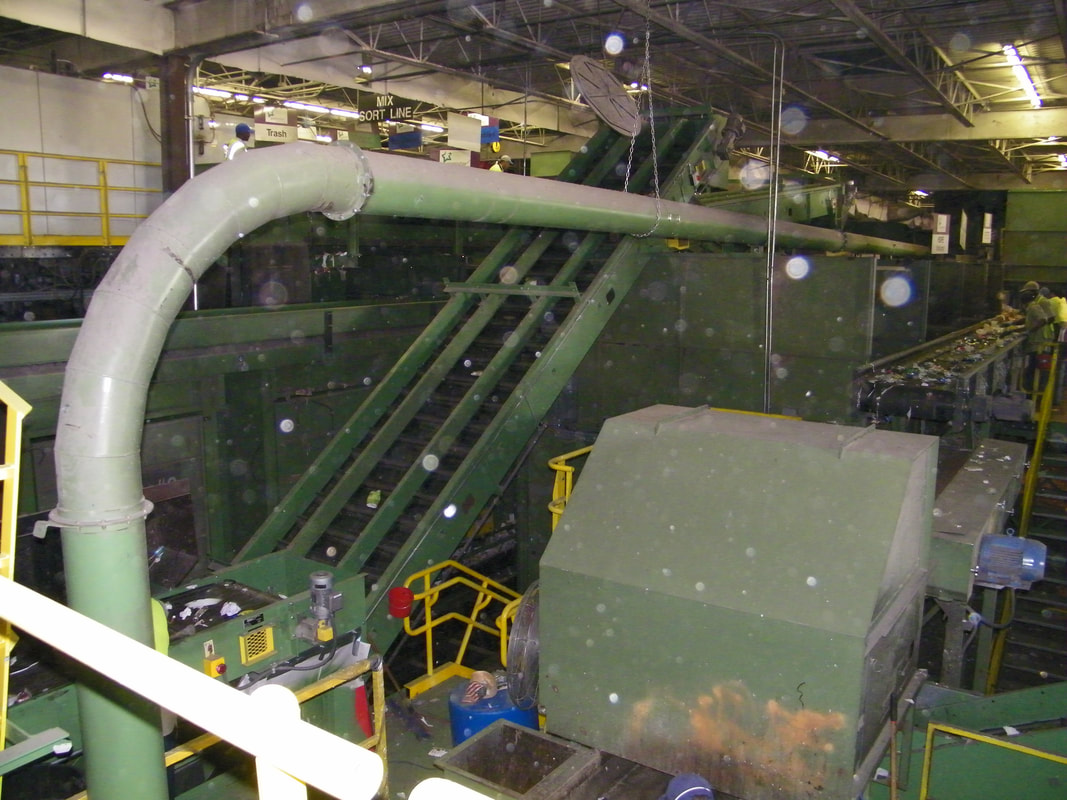
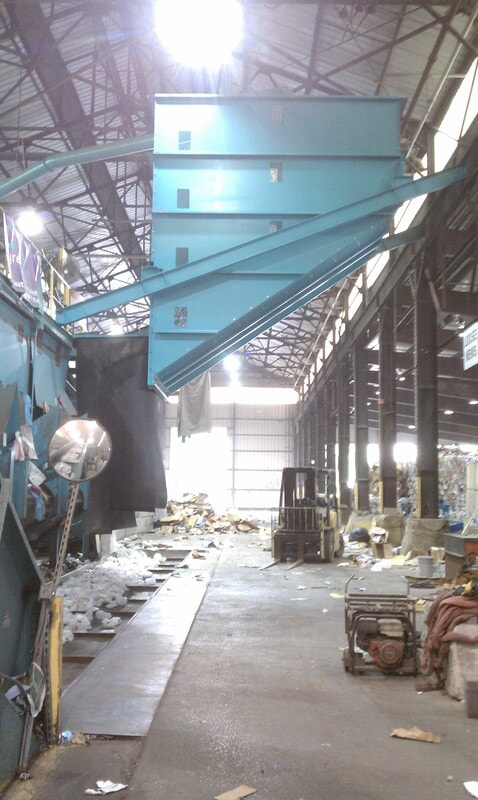
Tubing and Heavy-Duty Custom Hangers
We have also provided and installed the tubing and heavy-duty custom hangers as needed, in difficult areas where "off-the-shelf" parts would not work. If your building's structure makes the routing difficult, we fabricate the supports that make the routing work.
About our installation services →How Remcon Integrates Blowers with Conveyors and Bins
The blower is bought from another manufacturer. We specify New York Blower units. We build the rest of the installation around them. This work includes the tubing runs and the heavy-duty hangers that carry them. This work also includes the feed point where material enters the air stream, and the conveyors and bins at either end. Naming the blower matters for the same reason we name the drive on a conveyor. The blower is a catalog part with a published curve and its own parts supply. So you do not depend on us for it.
A blower is rarely a standalone machine: it is one part of a system. We have incorporated blowers into systems where they work alongside our belt conveyors and storage equipment:
- Filling elevated storage: a blower tube feeds an elevated storage bin or silo mounted over a baler feed conveyor (FIG. 02). Sorted material accumulates overhead, then discharges down onto the belt when the baler needs it.
- Carrying past obstructions: overhead tube runs move material over equipment, walkways, and work areas that a floor-level conveyor could not cross (FIG. 01).
- Separation lines: on eddy current aluminum separator lines, we build the infeed and outfeed conveyors, blowers, transitions, and chutes around the separator.
Because we design the whole turn-key system, the blower's discharge, the bin below it, and the conveyor after it are engineered together. They are not bolted together afterward.
Blower Conveying System Specifications
Every blower system is engineered for the specific material and building, so the specifications below are qualitative. The numbers come from the quote.
| Item | Remcon approach |
|---|---|
| Materials handled | PET, HDPE, tin cans, plastic film, and other light sorted materials |
| Blower | Selected and sized to the material and the run, and quoted per job |
| Tubing | Provided and installed; routed through turns, elevation changes, and tight spaces as the building requires |
| Hangers & supports | Heavy-duty custom hangers, fabricated for difficult areas where off-the-shelf parts would not work |
| Discharge | Into hoppers, storage bins, or silos, or onto the next conveyor |
| Integration | Engineered alongside Remcon belt conveyors, bins, and separation equipment in turn-key systems |
| Installation | Above-ground and overhead routing; installed by Remcon crews |
Blowers & Pneumatic Conveying FAQ
What is pneumatic conveying?
Pneumatic conveying (also called air conveying) moves material through a tube on a stream of air generated by a blower. The material moves on air instead of on a belt or chain. Material is fed into the air stream and carried through the tube in suspension. The material is released at the discharge end into a bin or hopper, or onto the next conveyor. The conveying path is only tubing, so the run can make multiple turns and changes in elevation that a belt conveyor cannot.
When should I use a blower instead of a belt conveyor?
Use a blower when the material is light enough for air to carry and the routing is the problem. These routing problems include tight spaces, multiple turns, and changes in elevation. Routing problems also include an elevated bin or silo that a belt could only reach with a long incline. Use a belt conveyor when the material is heavy, dense, or mixed. Also use a belt conveyor when sorters need to see and reach the material. Also use one when the run is straight and there is floor space for a frame. Many plants use both. These plants use belts for sorting and metering, and a blower to carry sorted material to storage.
What materials can be conveyed with a blower?
Remcon has incorporated blowers in systems for conveying PET, HDPE, tin cans, plastic film, and other materials into hoppers or storage bins. Air conveying suits light, sorted, free-moving material. Dense, heavy, or highly mixed streams stay on mechanical conveyors.
Does Remcon install blower conveying systems?
Yes. The blower itself is bought from another manufacturer. We build and install the rest of the blower system around it. This work includes the tubing runs and the heavy-duty custom hangers that carry them. The hangers are fabricated for difficult areas where off-the-shelf parts would not work. This work also includes the feed point where material enters the air stream, and the conveyors and bins at either end. The systems we have built carry light, sorted recyclables such as PET, HDPE, tin cans, and plastic film. Dense, heavy, or highly mixed streams stay on mechanical conveyors, because air can only carry what it can lift.
How much does a blower conveying system cost?
Every blower system is quoted for the specific job. Cost depends on the material, the conveying distance, and the number of turns and elevation changes. Cost also depends on the tubing routing and supports the building requires, and on the discharge point. Tell us the material, where it starts, and where it has to go. We will quote the blower system. If a simpler, less expensive belt conveyor can do the job, we will tell you that instead. Call (509) 244-9439 for a quote.
Custom Designed for Your Plant
The tubing supports, hangers, and the conveyors and bins that a blower works with are designed and fabricated at our Airway Heights (Spokane), Washington shop. They are then shipped and installed nationwide by our own crews.
We specialize in custom designed and fabricated equipment. We can work with you to design equipment that will work well for your needs. Contact us to discuss options or to get a quote.
Get a quote for a blower system →