
Rotating drum trommel screens, also called drum screeners or trommel machines, work well for sizing and separating any mix of materials. Screen openings are available in different sizes. Multiple sizes can be installed on the same trommel drum for graduated sizing and separating. One drum gives you several size fractions, with no moving screen decks to feed or maintain.
What Is a Trommel Screen?
A trommel screen, also called a rotating drum screen, is a perforated cylinder. The cylinder turns slowly on its axis while material passes through it. As the drum rotates, the material inside tumbles. The material is lifted partway up the drum wall, falls back, and moves toward the discharge end. Every tumble presents the material to the screen surface again. Pieces smaller than the openings fall through. Everything larger travels the length of the drum and discharges off the end. The tumbling action also helps break up clumps and shake small pieces loose from larger ones, so a trommel handles a dirty, commingled stream well. The result is separation by size, done with one slow-turning drum. This mechanical simplicity is the reason for the trommel's reputation as a low-cost way to screen a mixed stream.
Graduated Screening: Multiple Opening Sizes on One Drum
A drum with a single opening size splits a stream two ways: what falls through and what does not. The trommel's key feature is graduated screening. Multiple screen opening sizes can be installed on the same trommel drum, arranged from smallest at the infeed end to largest toward the discharge. Material meets the smallest openings first, so the finest fraction drops out early. As the remaining material travels down the drum, each larger opening size in turn removes its own fraction. Material that is too large for the last section discharges off the end of the drum as oversize.
Each section drops its fraction into its own collection point below the drum. So a single rotating drum trommel screen can replace what would otherwise take several separate screening steps. One machine produces three, four, or more sized streams in a single pass.

What Materials Does a Trommel Screen Sort?
Any mix that separates by size is a candidate. Common applications for this type of machine include:
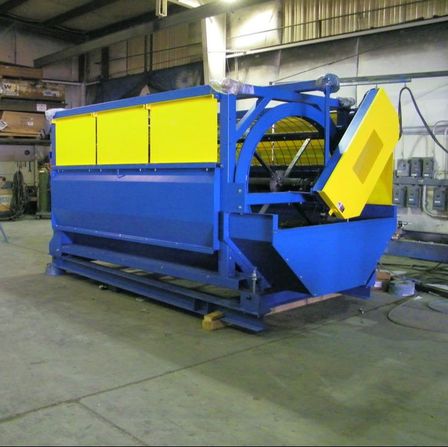
- Glass & cans: Broken glass falls through small openings while whole aluminum and tin cans carry over. The trommel splits a container stream into a glass fraction and a can fraction. The trommel pictured above was built for this duty.
- Fines removal: Grit, dirt, caps, and glass shards drop out of a single-stream or solid waste line early. Early removal keeps these fines from grinding against belts, bearings, and downstream equipment.
- Compost & organics: Finished compost screens away from oversize wood and unbroken material. The oversize wood and unbroken material can be returned for further processing.
- Construction & demolition (C&D) debris: Soil and small rubble separate from the larger wood, metal, and concrete that sorters or machines recover downstream.
Where a Trommel Sits in a Recycling Line
A trommel is usually worth having early in the line. Screening by size ahead of the sort gives the people and machines downstream a cleaner, more uniform stream. Also, the abrasive fines that wear out belts are gone before they travel the length of the plant.
An infeed conveyor meters material into the high end of the drum at a controlled rate. If material is fed to a trommel in surges, the surges bury the screen surface, just as they bury a flat screen. Below the drum, collection hoppers deliver each undersize fraction to its own takeaway conveyor. Oversize off the end of the drum goes on to the next stage. Depending on the plant, the next stage is a sort line, an eddy current separator, an overhead magnet, or a baler. The trommel is one machine in that chain. The conveyors, chutes, and structures around it turn it into a working line.
Trommel, Disc Screen, or Vibratory Screen?
All three screen by size. Many plants run more than one. A trommel tumbles material inside a rotating drum. This action is simple and forgiving, and it suits dirty, commingled streams and graduated multi-fraction screening. A disc screen moves material across banks of rotating discs and also separates flat fiber from rounder containers. The disc screen does the hard work on single-stream paper lines. A vibratory screen stratifies material on a vibrating deck for precise sizing. Remcon builds trommel drum screens in-house. We source disc and vibratory screens from their manufacturers and integrate them into the line. If you are not sure which screen your material needs, tell us the material mix and we will help you choose.
Trommel Screens from Remcon
Remcon builds multiple types of equipment designed for the sorting and separation of different types and sizes of materials. Trommel drum screens are part of that product line. See the full sorting & separation catalog. We specialize in custom designed and fabricated equipment. The drum, its screen opening sizes, the enclosure, and the collection hoppers are configured to your material and your building. The trommel is integrated with the conveyors that feed it and take each fraction away. We design and fabricate every Remcon trommel at our Airway Heights (Spokane), Washington shop. We then ship and install it nationwide.
Trommel Screen Specifications
Because every trommel is built to order, the numbers come from your application rather than a catalog page:
| Specification | Remcon approach |
|---|---|
| Drum diameter & length | Sized to the application. The two generic sales drawings below are drawn around a 60" drum and a 36" drum (reference dimensions under Trommel Drawings) |
| Screen openings | Different opening sizes available, chosen for the fractions you need to separate |
| Graduated sections | Multiple opening sizes can be installed on the same drum for graduated sizing and separating |
| Fractions produced | One undersize fraction per opening size, plus oversize off the end of the drum |
| Enclosure & collection | Guarding, enclosure panels, and collection hoppers configured to the application |
| Infeed & takeaway | Integrated with the conveyors that feed the drum and carry each fraction away |
| Installation | Shipped and installed nationwide from Airway Heights, WA |
Trommel Screen FAQ
What is a trommel screen?
A trommel screen, also called a rotating drum screen, is a rotating perforated drum that sizes and separates a mix of materials. As the drum turns, material tumbles inside it. Pieces smaller than the screen openings fall through, and larger pieces travel on to discharge at the far end. Rotating drum trommel screens work well for sizing and separating any mix of materials.
How does a trommel screen separate different sizes of material?
A trommel separates by the size of its screen openings. Anything that fits through the openings falls through, and everything larger keeps traveling down the drum. Screen openings are available in different sizes. Multiple sizes can be installed on the same trommel drum, smallest openings first and largest last. So a single drum produces several clean size fractions in one pass, each dropping into its own collection point.
What materials can a trommel screen handle?
A trommel screen can handle any mix of materials that separates by size. Common uses include separating broken glass from aluminum and tin cans in container streams and removing fines and grit from single-stream recycling. Other uses are screening finished compost away from oversize and removing dirt and small debris from mixed construction and demolition (C&D) loads. We have built trommel drum screens for jobs such as glass and aluminum can separation.
How much does a trommel screen cost?
Every Remcon trommel is custom designed and built, so price is quoted per job rather than from a catalog. The main cost drivers are drum size, the number of screen opening sizes on the drum, the drive arrangement, and enclosures and guarding. The conveyors and chutes that feed the drum and carry each fraction away are also cost drivers. Tell us the material mix and what has to come out of it. We will quote it. Call (509) 244-9439.
What size trommel does Remcon build?
Trommels are sized to the application, so there is no catalog size. Our two generic sales drawings show the scale that they are usually drawn around. One is a trunnion-style trommel with a 60" drum (61½" inside diameter, 53" infeed opening, 11 feet 8" screen frame). The other is a center-axle style with a 36" diameter, 84" long drum in a frame about 126" long and 53" wide. Both sit on a support stand with extra mounting holes so the screen incline can be changed. The drawings show 7 degrees.
We specialize in custom designed and fabricated equipment. We can work with you to design equipment that will work well for your needs. Contact us to discuss a trommel for your line or to get a quote.
Get a quote for a trommel screen →Trommel Drawings
Remcon builds trommels in two styles. Two generic assembly drawings show the basic design features of each style. The trunnion-style sheet is dimensioned for a 60" diameter drum. The center-axle sheet is dimensioned for a 36" drum.
Trommel, trunnion style (PDF) → Trommel, center-axle style (PDF) →Reference Dimensions, as Drawn
Every trommel is sized to its application. The table below lists the dimensions on the two generic drawings, for scale:
| Dimension | Trunnion style, 60" drum | Center-axle style, 36" drum |
|---|---|---|
| Drum | 61½" inside diameter and outfeed opening, 53" infeed opening | 36" diameter, 84" long |
| Length | 11 feet 8" screen frame | 125 15/16" overall, infeed hopper to discharge chute |
| Width | 7 feet 2" at the ends, 7 feet 4¼" across the discharge chutes | 53⅛" |
| Height on the stand | About 8 feet 2" at the 7-degree incline drawn | 57 7/16" to the top of the infeed hopper |
| Drum support | Trunnion wheels running on rolled plate at the drum ends, plus a thrust wheel. The wheels are fully guarded with hinged access covers. | Center axle, motor at the discharge end |
| Incline | Support stand with additional mounting holes for changing the screen incline. Both drawings show 7 degrees. | |
| Access & guarding | Side walls with hinged doors. Screen frame end flanges are computer-burned, not rolled, for roundness. | Hinged top covers for screen access, and enclosed sides |
| Chutes | Infeed hopper, unders chute, and discharge chute on both. The trunnion drawing adds a discharge hood. | |