
A drag chain conveyor moves material by dragging — the chain lies flat on its side and slides along low-friction tracks, pulling the carrying surface with it. Bolt steel flights between the chains and it drags material straight along a steel bed. Bolt on rubber or PVC belting instead and it becomes the workhorse feed conveyor of the recycling industry. Remcon builds both, on the same heavy-duty platform.
What Is a Drag Chain Conveyor?
A drag chain conveyor is a chain conveyor whose chain slides — drags — rather than rolls. Two parallel strands of welded steel chain lie flat on their sides and slide along tracks made of angle iron with UHMW wear surfaces to reduce friction. Steel cross members connect the two strands at regular intervals and either drag material directly along a solid bed (the steel-flight style) or carry rubber or PVC belting (the belt style). The chain is guided around both ends of the conveyor on sprockets; the sprockets at the discharge end grab the chain as the shaft is turned by a motor with a reducer, so the drive is positive — the belt cannot slip the way a friction-driven belt can. And because the pulling element is chain, it can be repaired link by link.
Drag chain is one branch of the chain conveyor family, alongside roller chain belts and bulk container conveyors.
See all chain conveyor styles compared →Two Drag Chain Styles: Steel Flights or a Belt
Drag Chain with Steel Flights (Beltless)
The beltless drag chain conveyor has no belt surface to puncture or bend. Steel cross angles — 3 x 3 x 1/4" angle iron, standard — are bolted between the two chains and slide along a solid conveyor bed, pulling material with them. The bed is built in replaceable sections of 1/4" steel plate, with hardened plate or UHMW-covered steel available for harder duty. This open-frame style works especially well for metering material being fed out of a hopper, and it is a common choice for conveying metal.
Full details: drag chain with steel flights (beltless) conveyors →Drag Chain with Rubber or PVC Belt
The drag chain belt conveyor is the most basic type of chain belt. Rubber or PVC belting is bolted to 4" x 3/8" steel flat-bar cross members which connect the two strands of chain, giving a flexible yet durable carrying surface for a variety of materials. The belting is heavy — 3-ply, 330 lbs. per inch width MOR rubber, or 450 lb. PVC — and UHMW-faced impact beams back it up in the loading area, where the abuse happens.
Full details: drag chain with rubber/PVC belt conveyors →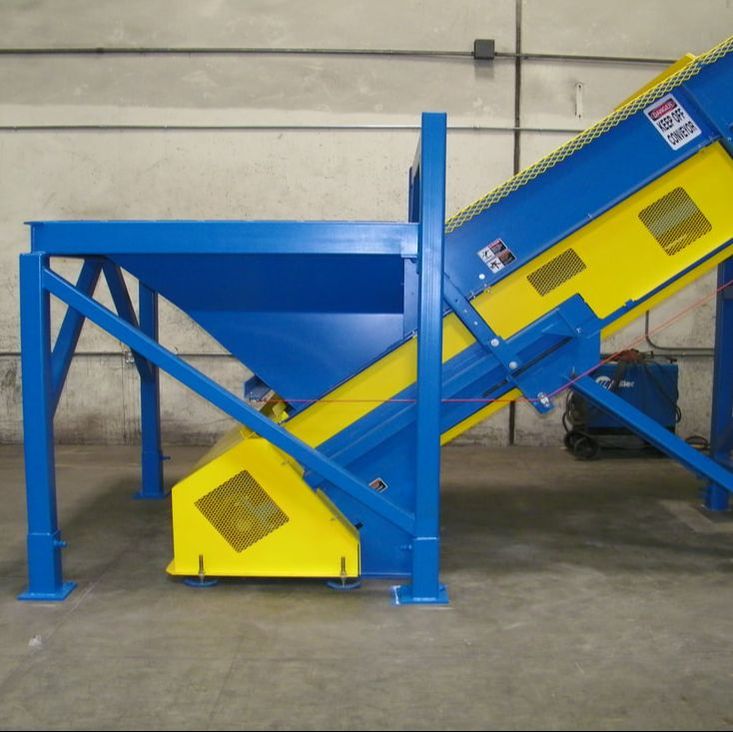
Steel Flights vs. Rubber/PVC Belt Compared
Both styles share the same chain, tracks, and drive — the difference is what the chain pulls. The table below is drawn from the two product entries above; follow those links for full construction details.
| Factor | Steel flights (beltless) | Rubber/PVC belt |
|---|---|---|
| Carrying surface | None — 3 x 3 x 1/4" steel cross angles drag material directly along the bed | Rubber or PVC belting bolted to 4" x 3/8" steel cross members between the chains |
| Conveyor bed | Solid, replaceable sections of 1/4" steel plate; hardened plate or UHMW-covered steel optional | No solid bed — the belt carries the load, with UHMW-faced impact beams under the loading area |
| Best materials | Metal and abrasive, metal-laden material — anything that would puncture, cut, or bend a belt | Mixed recyclables and solid waste — the workhorse belt for MRF feed duty |
| Wear & repair | Bed sections, UHMW chain tracks, and hold-down guides all bolt on and off; chain repairable link by link | Belting is a replaceable item; UHMW chain tracks and hold-down guides bolt on and off; chain repairable link by link |
| Belt width | 24" to 72" | 24" to 72" |
| Chain | 4" pitch or larger, welded | 4" pitch or larger, welded |
| When to choose | Scrap and metal conveying; metering out of a hopper; belt-damaging material | Baler feed, infeed, and sort line duty where a continuous surface keeps material on the conveyor |
One Platform Under Both Styles
Whichever carrying surface fits your material, the machine underneath is the same Remcon build:
- Drag chain tracks — steel angle iron faced with 1/2" thick x 6" wide black reprocessed UHMW polyethylene. The plastic bolts on, replaces easily, and has slotted holes for thermal expansion.
- Hold-down guides — Remcon's special UHMW guides carry the chain up or over curves where the conveyor changes angle; easily replaced.
- Take-ups — cantilevered telescoping tube style with manual screw adjustment: 12" of travel on shorter conveyors, up to 18" on the longest, adjusted with one wrench.
- Drive — shaft-mounted Dodge Torque Arm II reducer, v-belt driven. If the conveyor jams, the v-belt slips instead of something breaking; a VFD is especially recommended on chain belt conveyors.
- Frame — heavy-duty structural steel open frame, shop fitted and welded in sections up to 40 ft., aligned in the shop and aligned again at installation.
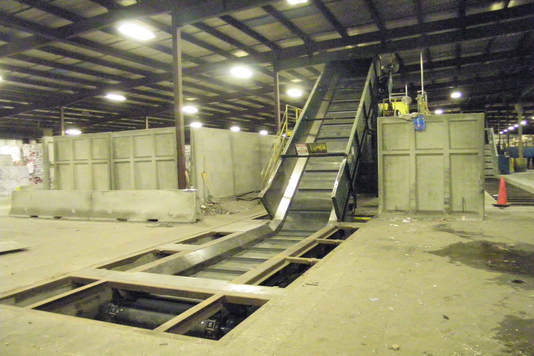
Every orientation runs in-ground (in a pit) or above ground: horizontal, incline, incline with nose-over, dual-angle incline, horizontal with elbow-up incline — or two conveyors in series.
The Chain Itself, by Designation
"4" pitch or larger, welded" is the honest short answer, and it is worth unpacking. Pitch is barrel centre to barrel centre. On a drag chain conveyor it decides how the strand wraps the sprockets at each end, how many teeth those sprockets carry, and how often a cross member can be attached along the run. Go finer and the chain articulates more smoothly but carries less; go coarser and the strand gets stronger and the wrap gets lumpier.
Remcon specifies Webster Industries welded steel mill chain on this family. The designations that recur on drag chain drawings are WR78-4 and WH124 or WHX124, all at a 4.000" pitch, and WH111+ at 4.760" where the belt is wide and the load is heavy. The N102B and N131 combination chains, which carry cast blocks on steel sidebars, appear on replacement work where an existing belt has to be matched. These are standard designations under ASME B29.200 rather than Remcon part numbers, so the chain in the machine can be sourced from more than one chain maker. The chain conveyors hub sets out the full list with pitches.
How the strand is put together matters as much as which strand it is, because it is what makes "repairable link by link" a real procedure rather than a slogan. Remcon chain is riveted unless it is specified with cotter pins, and the specification is deliberate: cottered connecting links are placed at every sixth pitch, with the connecting links themselves shipped loose so they are on site when they are needed. A riveted joint is permanent. A cottered joint at regular intervals means a damaged length can be broken out and a new length dropped in without touching the rest of the strand.
Which way the pins face is called out too, and it is not cosmetic. On the belt machines the note reads that all pins face outward, with the cotters on the outside of the chain and all pointing the same direction, and it gives the reason: a cotter on the inside will strike the back bar tab. Which side is the clear side depends on what is welded to the strand, so it is a drawing call rather than a habit, and chain assembled the wrong way round will run for a while before it tells you.
Standard vs. En-Masse Drag Conveying
In industry catalogs, "drag chain conveyor" covers two different working principles, and it helps to know which one you're shopping for. A standard, flight-style drag conveyor — the style on this page — pulls a loose bed of material along an open bed or trough with flights, and the material can tumble and settle as it moves. An en-masse conveyor instead runs a skeletal chain through an enclosed casing, and the material moves together as a solid column at close to chain speed. En-masse designs are common for fine, free-flowing bulk solids such as grain, wood chips, and ash, where the enclosed casing controls dust.
Remcon's version of bulk-material drag conveying is the single-strand drag chain: one wide strand of chain slides along a flat wear surface, dragging loose material with it — either just the material inside the links, or inside and on top of the chain, which is en-masse conveying. For sorted recyclables and solid waste, though, the flight and belt styles above are almost always the right call. Contact us if your material is a loose bulk solid and you're not sure which principle fits.
Chain Tension Is the Whole Maintenance Story
Remcon wrote a chain information sheet for drag chain conveyor owners, and most of what it says is about tension. Not because tension is complicated, but because it is the one adjustment that has to keep happening after the machine is installed and paid for.
What the sheet tells the person with the wrench:
- There should be no excessive sag in the chain. Tension it approximately as drawn, or a little tighter, and the chain should run smoothly when test-run empty.
- The tension has to be adjusted regularly as the chain wears. The two things being avoided are loose links catching on the sprocket, and the chain barrels wearing prematurely.
- To adjust: loosen the bearing bolts, turn the tension adjustment screws equally on both sides of the conveyor, then re-tighten the bearing bolts. Equally on both sides is the part people skip.
- If you run out of take-up travel, a chain link can be removed to shorten the chain. That is the intended end of the adjustment range, not a failure.
- Sprocket teeth contact the round side of the chain barrel. Knowing that makes a worn sprocket obvious from the shape of the tooth face.
- Where the machine has a head shroud, it comes off with its mounting bolts to expose the chain and the sprocket. The sprocket has a fixed keyed bore and is held to the shaft with two set screws.
The take-up range gets used from the middle rather than from one end. On a 2025 chain layout the length was chosen specifically so the new chain would sit in the middle of the take-up travel, leaving room to adjust in both directions instead of starting at one stop with nowhere to go.
Some of that is settled before the machine is assembled. One of our shop instructions has the strands checked for straightness by dragging them back and forth on the floor and checking them against a string or a straightedge, then arranging them so the curvature that is left is spread rather than stacked. New chain is not automatically straight, and a strand is easier to argue with on the floor than in a frame.
Drag Chain Conveyor Applications
Drag chain conveyors live at the feed end of recycling plants, MRFs, and scrap operations — the point where a loader or a hopper meets the processing line and the material is at its roughest. Both styles are commonly built as:
When the load gets heavier still, the next step up is the roller chain belt conveyor — the same principle, but with rollers in each link that roll on rail, moving heavier loads with less power.
Speed, Horsepower, and Why These Machines Are Drawn Slow
Drag chain conveyors are not fast, and that is the point. Chain speeds on Remcon drag chain drawings sit in ranges like 8 to 48 feet per minute on a variable frequency drive with a five horsepower minimum, or 20 to about 53 feet per minute with a seven and a half horsepower minimum. Some drag chain runs at 80 feet per minute. Each of those is a job-specific number, set against the material and the rate the next machine wants to be fed at, and none of them is a house standard.
The drive is sized off chain pull rather than belt tension. Chain pull times speed, with allowances for drive efficiency, gives the horsepower, and it is a different calculation from a friction-driven conveyor where the belt tension needed for grip drives the number.
The more interesting question is why the speeds are not higher, since a faster conveyor moves more material with the same motor. One drive study on file answers it: 40 feet per minute was chosen as the best compromise between top speed and deceleration rate, because too high a deceleration rate would have called for dynamic braking. A chain belt cannot slip. A friction belt that is asked to stop too fast simply slides on the pulley and takes the shock out of the system, which is inefficient and also a mercy. A chain belt has no such release, so everything that is moving has to be stopped by the drive and the frame, and the way to keep that manageable is not to have it moving very fast in the first place.
Layout costs horsepower too. Where a conveyor curves, our own note is blunt about it: the less curvature the better, for reduced horsepower and reduced wear on the chain guides. Every degree of curve is chain being pulled around a corner rather than along a straight line. Where the curve is unavoidable, the chain guides through the curved section are lined with UHMW plastic so the chain is sliding on plastic exactly where it is pressing hardest.
Drag Chain Conveyor FAQ
What is a drag chain conveyor?
A drag chain conveyor is a chain conveyor whose chain slides — drags — along low-friction tracks instead of rolling, pulling the carrying surface along with it. Remcon builds two styles: steel flights (beltless), where steel cross angles drag material along a solid steel bed, and rubber/PVC belt, where belting bolted to steel cross members carries the load. Both use a positive sprocket drive, so the belt cannot slip the way a friction-driven belt can.
What is the difference between a drag chain and a roller chain conveyor?
A drag chain conveyor slides its chain flat along angle-iron tracks with UHMW wear surfaces, while a roller chain conveyor has steel rollers built into each link that roll on rail tracks instead of sliding. Rolling reduces the drag of the belt as it travels, so a roller chain conveyor can move a heavier load with less power. The drag chain is the simpler, more basic build — and for most feed and metering duty, it is all the conveyor the job needs.
Steel flights or a rubber/PVC belt — which drag chain conveyor do I need?
Choose steel flights (beltless) when the material would puncture, cut, or bend a belt — metal, most of all — or when metering material out of a hopper. Choose a rubber or PVC belt when mixed recyclables need a continuous carrying surface for baler feed, infeed, or sort line duty. Both styles ride on the same UHMW tracks, take-ups, and drive platform, so the choice comes down to the material.
What materials do drag chain conveyors handle?
Drag chain conveyors are built for the rough end of recycling and solid waste — mixed recyclables on the belt style, and metal and other abrasive, belt-damaging material on the steel-flight style. Both are commonly built as baler feed, infeed, and sort line feed conveyors for recycling plants and MRFs, installed in-ground (in a pit) or above ground.
How much does a drag chain conveyor cost?
Price depends on the style (steel flights or belt), width, length, orientation, hoppers, and drive options, so Remcon quotes each drag chain conveyor individually. Tell us the material, the load, and the layout and we will quote it — and if a simpler conveyor such as a slider bed can do the job for less, we will tell you that too. Call (509) 244-9439 for a quote.
What chain goes in a Remcon drag chain conveyor?
Welded steel mill chain from Webster Industries, 4" pitch or larger. The designations that recur on our drag chain drawings are WR78-4, WH124 and WHX124 at 4.000" pitch, and WH111+ at 4.760" where the belt is wide and heavily loaded; the N102B and N131 combination chains turn up on replacement work. These are standard designations under ASME B29.200, not Remcon part numbers, so the chain can be sourced from more than one manufacturer. Chain is selected per job rather than fixed.
How do I tension the chain on a drag chain conveyor?
Loosen the bearing bolts, turn the tension adjustment screws equally on both sides of the conveyor, then re-tighten the bearing bolts. There should be no excessive sag, and the chain should run smoothly when test-run with no material on it. Re-check it regularly as the chain wears, because a slack strand lets loose links catch on the sprocket and wears the chain barrels early. If the take-up runs out of travel, remove a chain link to shorten the chain.
How fast does a drag chain conveyor run?
Slowly, by design. Speeds on Remcon drag chain drawings sit in variable frequency drive ranges such as 8 to 48 feet per minute or 20 to about 53, with some drag chain running at 80. The number is set per job against the material and the feed rate the next machine wants. Speed is also limited by deceleration: a chain belt cannot slip, so everything moving has to be stopped by the drive, and a conveyor drawn too fast can end up needing dynamic braking to stop safely.
Every Remcon drag chain conveyor is designed and fabricated at our Airway Heights (Spokane), Washington shop, then shipped and installed nationwide — with replacement chain, belting, and parts supplied for the life of the machine. Tell us the material and the layout, and we'll tell you which style it wants.
Get a quote for a drag chain conveyor →